


Best Field Service Management Software 2026: An Oilfield Buyer's Shortlist
The short version: If you run frac, wireline, vacuum, or swab operations, the best field service management software 2026 is not a generic CRM with a map view. It is a system built around the oilfield ticket lifecycle, from the dispatcher's desk to the company man's signature. You need one that handles PIDX, Cortex, and OpenInvoice without a fight. You need one that your pumpers will actually use in a dusty pickup at 2 AM. This guide shows you what to buy, what to avoid, and how to measure the ROI in barrels and days, not vague promises.
Why the Best Field Service Management Software 2026 Is a Cash Flow Decision
Every operator in the Permian Delaware or the Bakken runs the same race. You fight for the same frac spreads. You pay the same rates for top drives and triplex pumps. The only real difference between the winners and the broke is how fast you turn field work into cash.
The best field service management software 2026 does one thing better than anything else. It compresses the gap between the moment a crew finishes a job and the moment the money hits your account. That gap is measured in days. Days cost you working capital. Working capital buys iron, fuel, and payroll.
Consider a mid-sized wireline operator running five units in the Eagle Ford. Average ticket value is $18,000. You run 40 jobs a month. That is $720,000 in gross revenue sitting in the pipeline. If your DSO is 65 days, you are financing that entire amount. At a 9% cost of capital, that is roughly $11,500 a month just in interest drag. That is a full wireline engineer's salary gone, every month, for nothing.
The software you pick must attack that DSO directly. It is not about pretty dashboards. It is about getting a clean, approvable ticket into the operator's system on the same day the job finishes.
The Real Financial Drain: Ticket Errors and the 14-Day Reject Cycle
Let me show you the arithmetic that kills oilfield service companies. It is not the cost of the software. It is the cost of the errors the software is supposed to prevent.
A vacuum truck operator in the Midland basin sends a driver to haul 120 barrels of produced water. The driver writes the ticket by hand. He misreads the gauge by 4 barrels. He writes the wrong lease number. He forgets to check the "hot oil" box. The ticket goes to the operator's field office. The company man rejects it because the lease code does not match the AFE.
Now the ticket sits in a pile on a dispatcher's desk for three days. It gets re-faxed. It gets re-entered. The operator's AP department kicks it back again because the decimal point is in the wrong place on the volume. Total delay: 14 days. Total cost of that single error: the time of three office staff, the re-dispatch of a truck to get a new signature, and the working capital cost of a $4,200 ticket that should have been paid in 10 days but now takes 24.
Multiply that by 30 trucks and you have a permanent, invisible tax on your revenue. The best field service management software 2026 eliminates the hand-written ticket entirely. It forces validation at the source, in the cab, before the driver leaves the location.
Show Me the Math: The Cost of a Broken Ticket Workflow
The Hard Numbers on a 25-Truck Fleet:
- Average ticket value: $3,800 (vacuum, hot oil, frac water hauling)
- Tickets per month: 450
- Monthly revenue: $1,710,000
- Current DSO: 58 days
- Target DSO with digital ticketing: 32 days
- Cash released: $1,710,000 x (26/30) = $1,482,000 freed up
- Annual interest savings at 8%: $118,560
- Plus: elimination of 12% first-pass reject rate on tickets
- Plus: recovery of 6 hours per week per dispatcher previously spent chasing signatures
That is why you are not buying software. You are buying back a month of your cash cycle.
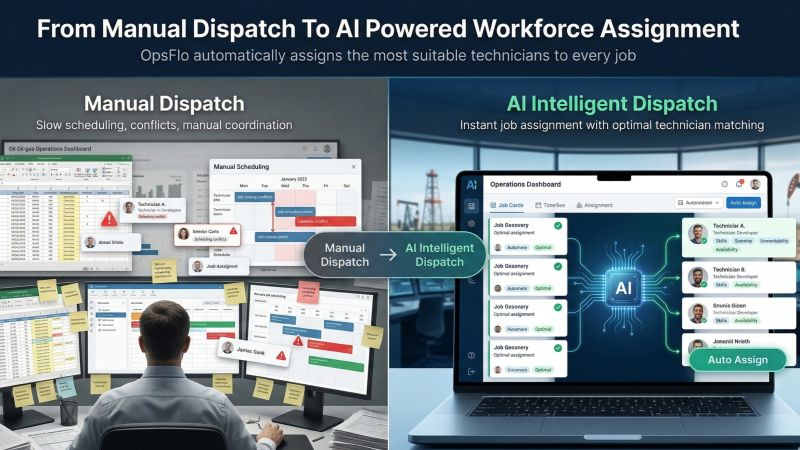
Why Generic Field Service Software and Spreadsheets Fail in the Dirt
I have seen operators try to run frac water logistics on a shared Google Sheet. It works for about two weeks. Then the toolpusher in the Haynesville types over the dispatcher's column. The pumper in the Permian enters the wrong date format. The office manager in Oklahoma sorts the sheet wrong and pays a vendor twice.
Generic field service software built for HVAC or plumbing is worse. It does not understand a multi-well pad where one frac spread services three different operators on the same location. It does not understand split tickets. It does not understand that the "customer" is a company man who changes his mind three times before breakfast.
The best field service management software 2026 must handle the specific chaos of the oilfield. It must handle the fact that your crew is working on a location with no cell signal for four hours. It must sync when the truck gets back to the highway. It must handle the fact that the company man signs with a gloved hand on a cracked screen. The UI must be built for thumbs, not for a mouse.
The Three Failure Points of Spreadsheet Dispatch
First, the data entry error. A dispatcher types a truck number wrong. The ticket goes to the wrong operator. The operator rejects it. You lose a week.
Second, the version control problem. You have the master schedule on your desktop. The field supervisor has a printed copy from yesterday. The pumper has a text message from the night before. Nobody is looking at the same job board. That is how you end up with two vacuum trucks at the same wellhead and zero at the one that actually needs it.
Third, the billing delay. The job finishes on the 3rd. The ticket sits in the truck door pocket until the driver comes back to the yard on the 7th. The office types it up on the 8th. It goes in the mail or the fax on the 9th. You have already lost six days of your DSO cycle before the operator even sees the invoice.
The best field service management software 2026 kills all three failure points at once. It is the difference between running your business on memory and running it on a live data feed.
Step-by-Step Operational Framework for Choosing Your Software
Do not start with a feature list. Start with your ticket path. Map the journey of a single ticket from the moment the dispatcher assigns the job to the moment the operator's AP system posts the payment. Identify every handoff, every signature, every re-key. That map is your requirement document.
Step one is mobile capture. The crew must be able to build a ticket on a phone or tablet in the field. It must include photos of the gauge, the trailer, and the location. It must timestamp the arrival and departure automatically. If the software requires a laptop in the truck, it is worthless.
Step two is the approval workflow. The ticket must route to the right person automatically. For a frac job, that is the frac consultant. For a swab job, that is the wellsite supervisor. They need to see it on their phone and approve it with one tap. No printing. No scanning. No faxing.
Step three is the integration layer. The software must speak the language of the big operators. That means PIDX for the majors. That means OpenInvoice and Cortex for the midstream and upstream players. If the software cannot push a clean XML file to the operator's system, you are still doing manual data entry, just with a nicer screen.
Step four is the back-office reconciliation. The software must match the approved ticket to the purchase order and the AFE. It must flag discrepancies before you invoice, not after the operator rejects it. This is where the best field service management software 2026 pays for itself in the first month.
Step five is the cash application. When the operator pays, the software must match the remittance to the invoice and close the loop. You need to know exactly which jobs are paid and which are still aging at 60 days.
Permian Field Case Study: Cutting DSO from 51 to 29 Days
Consider a real frac water hauling operation in the Permian Delaware. They ran 18 vacuum trucks and 4 frac tanks. They were moving 85,000 barrels of water per day across three different operators.
Their old system was paper tickets and a QuickBooks desktop file. The dispatcher used a whiteboard. The billing clerk spent 20 hours a week re-typing tickets and chasing down missing signatures. Their first-pass approval rate was 68%. That means nearly one in three tickets got rejected for something stupid: a missing date, a wrong unit number, a signature that did not match the AFE.
They switched to a digital field ticketing system built for oilfield workflows. They gave every driver a ruggedized phone mount and a stylus. The company men were skeptical at first. They did not want to tap a screen instead of signing a piece of paper.
The turning point came when the software automatically generated a PDF ticket and texted it to the company man's phone for approval. He could review the volumes from his office trailer without walking to the truck. Approval time dropped from an average of 22 hours to 40 minutes.
The 90-Day Results:
- First-pass ticket approval rate: 68% to 96%
- Average ticket approval time: 22 hours to 40 minutes
- Billing clerk overtime: eliminated (saved 15 hours per week)
- DSO: 51 days to 29 days
- Working capital released: $1.9 million on $4.2 million monthly revenue
- Disputed invoices: down 80%
That is the difference between a tool and a toy. The right software pays for itself in the first billing cycle.
Implementation Checklist for Supervisors and Office Dispatch
You do not flip a switch and get these results. You have to manage the change. The crew in the field will resist. The office staff will resist harder because they are afraid of losing their jobs to automation. You must be direct with them. The goal is not to fire the billing clerk. The goal is to turn the billing clerk into a cash flow analyst who chases the 30-day aging report instead of re-typing tickets.
Start with a pilot. Pick one district, one type of job, and one operator. Run that pilot for two weeks. Get the bugs out. Measure the approval time before and after. Show the crew the numbers. When the toolpusher sees that his job got approved in 30 minutes instead of 3 days, he will convert the skeptics for you.
Train the dispatchers first. They are the center of gravity. If the dispatcher does not trust the system, they will keep the whiteboard as a backup. That is fine for week one. By week three, you must erase the whiteboard. Do not allow a shadow system to exist. That is how errors creep back in.
Set a hard rule for the field. No digital ticket, no payment. The crew does not get paid for a job unless the ticket is submitted through the app before the truck leaves the location. You will get pushback for exactly one week. Then it becomes habit.
Finally, integrate with your accounting system on day one. Do not wait. If the software cannot push invoices to your ERP, you are creating a new data entry bottleneck at the back end. The best field service management software 2026 should close the loop from the cab to the general ledger.
Frequently Asked Questions
How is oilfield field service software different from generic job scheduling tools?
Generic tools schedule a plumber to a house. Oilfield software must handle multi-party approval, split tickets across multiple operators on one pad, and integration with PIDX, OpenInvoice, and Cortex. It must work offline in the Delaware basin where cell coverage is a rumor. It must handle the unit economics of a vacuum truck that costs $180 an hour to run. If the software does not know what a company man is, it will fail you on the first job.
What is the fastest way to reduce DSO in an oilfield service company?
Stop sending paper tickets. The fastest lever is digital field ticketing with immediate electronic submission. If you can get a clean, approved ticket into the operator's system on the same day as the job, you will cut 15 to 20 days off your DSO in the first quarter. The second lever is automated invoice matching against the AFE so you never send a wrong invoice. The third is daily aging reports so you know exactly which operator is slow paying and can stop sending trucks to their locations until they clear.
Will my crew in the field actually use this software?
Yes, if you make it easier than the paper process. The interface must be built for a gloved hand and a bright Texas sun. It must auto-fill the date, the time, and the GPS coordinates. The crew should only have to type the volume and get a signature. If they have to type the lease number and the well name and the ticket number, they will hate it and find a way around it. Test the software with your grumpiest pumper before you buy it.
How long does implementation take?
A focused operator can go live in 10 business days. The first two days are for setting up your equipment list, your customer list, and your price books. Day three is for integration with your accounting system. Days four and five are for training the dispatchers. The following week is the field pilot. If you are still implementing after 30 days, you have a process problem, not a software problem.
Clear Executive Takeaway
The best field service management software 2026 is not a luxury. It is a working capital machine. Every day you keep a paper ticket system, you are lending your revenue to the operators at zero interest. You are paying your billing clerk to type numbers that a truck driver already typed once. You are paying your dispatcher to chase signatures that should arrive by push notification.
The operators you work for have already digitized their AP departments. They are ready to pay you faster. They are ready to approve tickets from their phone while they sit in the company man trailer. The only thing stopping you is your own back office.
Stop treating software as an expense line item. Treat it as a revenue acceleration tool. If you are running 20 trucks in the Permian or 5 wireline units in the Bakken, the math is the same. A 20-day DSO reduction on $1 million in monthly revenue puts $660,000 back in your pocket. That is not a rounding error. That is the difference between buying a new triplex pump and watching your competitor buy it.
Look at a platform built for the oilfield, not retrofitted for it. Review the oilfield service management platform that handles the ticket lifecycle from the cab to the cash application. Run the numbers on your own fleet with the ROI calculator before you make a decision. See what a 15 day DSO improvement means for your specific revenue base.
The crew is ready. The operators are ready. The only question is whether you are ready to stop managing tickets
No comments yet
Be the first to share your thoughts.
Leave a Reply
Comments are disabled on the shared-hosting build. If you want to respond to this article, email info@ops-flo.com and mention "Best Field Service Management Software 2026: An Oilfield Buyer's Shortlist".
Contact OpsFlo