


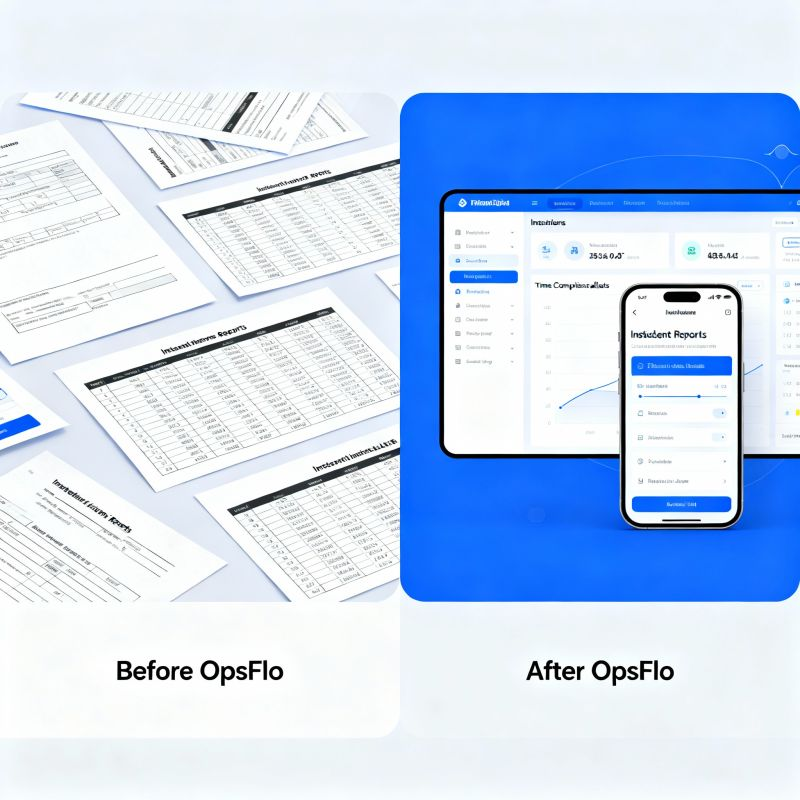
Book A Demo Field Ticketing Software Crews Actually Want To Fill Out
The Short Version: Your field tickets are the single most expensive piece of paper in your operation. Every hour a ticket sits in a truck console, in a dispatch inbox, or in a company man's approval queue is an hour your cash is stuck in the ground. If you want to fix your billing cycle, you need to book a demo field ticketing software that your pumpers, wireline hands, and frac supervisors will actually use without a fight.
The Core Operational Breakdown: Why Your Tickets Are Late
Let's start with the truth. The oilfield does not run on crude. It runs on paper tickets and verbal approvals. A wireline crew runs a plug-and-perf job in the Midland Basin. They finish at 3:00 AM. The engineer writes the ticket by headlamp on the tailgate of a pickup. He leaves a carbon copy with the company man. He drives 45 minutes back to the man camp. He takes a shower. He sleeps. The ticket sits in his glovebox until the next morning.
That ticket represents $180,000 of work. It is now 14 hours old. Nobody has seen it. Nobody has billed it. Nobody has even verified the pump strokes or the sand count match the job log.
This is not an isolated incident. This is the standard operating procedure for thousands of service companies across the Permian Delaware, the Eagle Ford, and the Bakken. The disconnect is structural. The field operates on a 24-hour clock. The back office operates on an 8-hour clock. The ticket is the handoff point between those two worlds, and it is failing.
The problem is not the crew. The problem is the tool. A crew that runs a modern top drive or a GPS-guided frac spread will not tolerate a paper ticket system that requires a fax machine. They live on their phones. They send photos of gauges to the company man before they pull the choke. They can calculate a cement volume in their head. But you hand them a triplicate form and a pen, and you have transported them back to 1985.
The core breakdown is simple. You have a mobile workforce with desktop expectations. You have a real-time operation with batch processing. You have a high-value transaction with zero audit trail. When you book a demo field ticketing software, you are not buying a form. You are buying a bridge between the rig site and the revenue cycle.
The Real Financial Drain: Show Me The Math
Let's put real numbers on this. Assume you run 20 frac spreads in the Permian. Each spread does an average of 2.5 jobs per week. That is 50 tickets per week. Your average ticket value is $150,000. That is $7.5 million in weekly revenue sitting in the approval pipeline.
Now look at your Days Sales Outstanding (DSO). Industry average for oilfield services is between 55 and 70 days. The operators you work for, the big E&P companies, they use systems like OpenInvoice or Cortex. They do not pay late because they are lazy. They pay late because your invoice does not match the field ticket. The coding is off. The ticket number is missing. The tax line is wrong. It gets kicked back to you. That is a 14-day reset on a 60-day clock.
Consider the arithmetic of a single kicked ticket. Your invoice is $150,000. It gets rejected due to a signature mismatch. You rework the invoice. You resubmit. The operator's AP cycle has already closed for the month. You wait another 30 days. At a 10% cost of capital, that 30-day delay costs you $1,250 in pure interest on that one ticket. Multiply that by the 5% to 10% of tickets that get rejected, and you are bleeding real money.
Then there is the non-productive time (NPT) angle. Every hour your field supervisor spends chasing a signature or re-typing a ticket is an hour they are not supervising the rig. A toolpusher making $80 an hour who spends 4 hours a week on paperwork is costing you $320 a week in lost supervisory capacity. Over a year, that is over $16,000 per supervisor in wasted labor. And that does not count the cost of the mistake they miss because they were looking at a screen instead of the drill floor.
The Cost of Paper: A Working Example
- Average ticket value: $150,000
- Tickets generated per week: 50
- Weekly revenue in pipeline: $7,500,000
- Current DSO: 62 days
- Target DSO with digital tickets: 48 days
- Reduction: 14 days of float
- Cash released: $7,500,000 x 2 (two weeks of billing) = $15,000,000
- Annual interest savings at 10%: $1,500,000
That is not a rounding error. That is a million and a half dollars a year that belongs to you, not to the bank. If you are skeptical, use the ROI calculator on our site. Punch in your own ticket counts and your own DSO. The math does not lie.
Why Generic Solutions and Spreadsheets Fail in the Field
Let me be blunt. A generic field service app built for HVAC technicians or plumbers will not survive a week in the Delaware Basin. The job types are too complex. The pricing structures are too varied. The approval chains are too rigid.
Consider a typical swab rig ticket. You have a day rate. You have a footage rate. You have a charge for the crew. You have a charge for the truck. You have a fuel surcharge. You have a charge for the separator. And you have a line item for "waiting on location" that the company man will fight you on every single time.
A spreadsheet cannot handle that complexity. You end up with a macro that breaks. You end up with a shared drive where three different versions of the same ticket exist. You end up with a dispatcher who has to manually re-type the ticket into the billing system because the columns do not map.
The other failure is the hardware. A ruggedized tablet is fine on a frac manifold. But a vacuum truck operator is not going to carry a tablet. He is going to carry his phone. If your software does not work flawlessly on a 5-inch screen with gloves on, in the rain, in the dark, at 2:00 AM, the crew will abandon it within a week.
And then there is the approval workflow. The company man is the gatekeeper. He has 15 vendors submitting tickets on his location. He is not going to log into a separate portal for each one. Your software must integrate with the systems he already uses. If you cannot submit a ticket through OpenInvoice or Cortex without a human touching it, you have not solved the problem. You have just digitized the paperwork.
Step-by-Step Operational Framework: From Rig Site to Revenue
The goal is not to eliminate the ticket. The goal is to eliminate the latency and the errors. Here is the framework that works.
Step 1: Capture at the Source
The ticket must be created on the device that is already in the crew's hand. No re-typing. No transcription. The wireline engineer opens the app, selects the job, and the pre-populated fields appear. The pump count is pulled from the digital job log. The sand volume is auto-calculated. The crew adds the exceptions, the waiting time, the extra runs. They take a photo of the gauge or the proppant ticket if there is a dispute. They sign with a finger. The company man signs on his own phone. The ticket is locked.
This is the moment of truth. If the crew can capture the ticket in under two minutes, they will use it. If it takes ten minutes, they will revert to paper. The software must be faster than the pen.
Step 2: Instant Transmission
The moment the company man signs, the ticket is transmitted to the cloud. It is not sitting in a truck. It is not waiting for a Wi-Fi connection at the man camp. It is in your dispatch office, your billing system, and your operations dashboard simultaneously. Your dispatcher can see the job is complete. Your billing clerk can see the revenue is pending. Your operations manager can see the efficiency metrics.
This is where digital field ticketing changes the game. You are no longer waiting for the end of the shift. You are no longer waiting for the end of the week. You are operating in real time.
Step 3: Automated Validation
Before the ticket hits the billing queue, the software checks it. Are the dates correct? Is the PO number valid? Are the line items priced correctly? Does the total match the contract rate? This is the audit trail that prevents the kickback.
Think about the tare weight errors on a vacuum truck ticket. The driver enters the gross weight and the tare weight. The software calculates the net. If the net exceeds the truck's capacity, the software flags it. That is a $2,000 error caught before it becomes a $2,000 dispute.
Step 4: Accelerated Billing
The ticket is now in your billing system. It is formatted for the operator's AP system. It is submitted electronically. You are not printing an invoice and mailing it. You are not emailing a PDF that will sit in an inbox for three days. You are submitting through the operator's preferred channel, whether that is OpenInvoice, Cortex, or a direct EDI feed.
This is the accelerated oilfield billing process. You are cutting days out of the cycle. You are cutting the rework rate to near zero. You are getting paid faster.
Permian Basin Case Study: The Metrics That Matter
Let me give you a real-world example from a pressure pumping company operating in the Permian Delaware. They were running 12 frac spreads. They had 40 field supervisors. They were generating 130 tickets a week. Their DSO was 71 days.
The problem was not the crews. The crews were excellent. The problem was the handoff. Tickets were written on paper. They were driven back to the district office. They were scanned and emailed to the billing team. The billing team had to re-key the data into their ERP. The error rate was 8%. The rework rate was 12%. The average time from job completion to invoice submission was 11 days.
They switched to a mobile-first digital ticketing system. The deployment took two weeks. The field supervisors were trained in one hour. The crews adopted it because it eliminated their end-of-shift paperwork.
The results after 90 days:
- Time from job completion to invoice: reduced from 11 days to 1.5 days
- Ticket error rate: reduced from 8% to 0.5%
- Rework rate: reduced from 12% to 1%
- DSO: reduced from 71 days to 54 days
- Cash released: $22 million (based on $110 million annual revenue)
- Billing clerk overtime: eliminated (saved $180,000 annually)
The operations manager told me the most surprising result. The company men at the operators started requesting their crews. Because the tickets were accurate and submitted immediately, the operator's field office had clean data. The company men trusted the numbers. That trust translated into more work for the service company.
Implementation Checklist for Supervisors and Office Dispatch
You cannot just buy software and expect it to work. You must implement it with the same discipline you use for a critical well operation. Here is the checklist.
Before You Deploy
- Map your current ticket flow. Draw it on a whiteboard. Identify every handoff and every delay.
- List your top 10 job types. Wireline, coiled tubing, cementing, frac, swab rig, vacuum truck, etc.
- Define the approval chain for each job type. Who signs? Who approves the exceptions?
- Set your pricing rules in the system. Do this before you deploy, not after.
- Choose your integration points. OpenInvoice, Cortex, your ERP. Get the API keys early.
During Deployment
- Start with one district or one crew type. Do not boil the ocean.
- Run parallel for one week. Paper and digital. Compare the results.
- Train the dispatchers first. They are the ones who will feel the change most acutely.
- Get the company men on board. Show them the digital signature process. It takes 10 seconds.
- Assign a champion in the field. A toolpusher or a frac supervisor who can help the others.
After Go-Live
- Review the error reports every day for the first two weeks.
- Check the ticket-to-invoice time daily. That is your most important metric.
- Survey the crews after 30 days. Ask them what is slow or confusing.
- Fix the friction points immediately. Do not wait for the quarterly release.
- Celebrate the wins. Show the crews the DSO improvement. Show them the cash released.
Frequently Asked Questions
Will my crews actually use this, or will they fight it?
Crews do not fight tools that make their lives easier. They fight tools that add work. If your current process requires them to write a ticket by hand and then also type it into a tablet, they will hate it. The right software replaces the paper. It does not add a step. The field supervisor signs on his phone and he is done. In our experience, adoption rates exceed 95% within two weeks when the software is designed for the oilfield.
How does this integrate with OpenInvoice and Cortex?
The big operators use these systems to manage their vendor invoices. Your digital ticket must map to their required fields. The software should format the invoice data to match the operator's requirements. It should submit electronically and track the status. You should see when the invoice is received, approved, and scheduled for payment. No more phone calls to the operator's AP department asking where the check is.
What happens when the company man rejects a ticket?
The rejection comes back to the field supervisor with the reason attached. The supervisor can correct the line item and resubmit from his phone. The audit trail shows the original and the correction. This is critical for dispute resolution. You have a record of exactly what changed and who changed it.
How long does implementation actually take?
For a company with 10 to 50 crews, the typical deployment is two to three weeks. The first week is configuration. The second week is training and pilot. The third week is full rollout. The fastest deployment we have seen was five days for a wireline company with 6 units. The longest was six weeks for a company with 200 trucks and multiple service lines.
Clear Executive Takeaway
The oilfield is a cash flow business disguised as an engineering business. You can have the best triplex pumps and the most experienced crews, but if your billing cycle is slow, you are leaving money in the ground.
The field ticket is the fulcrum. It is where the operational world meets the financial world. If you digitize that handoff, you compress your
To see how your team can eliminate this operational drag, explore the Book A Demo Field Ticketing Software Crews Actually Want To Fill Out solution on OpsFlo or schedule a diagnostic session with our operations engineering team.
No comments yet
Be the first to share your thoughts.
Leave a Reply
Comments are disabled on the shared-hosting build. If you want to respond to this article, email info@ops-flo.com and mention "Book A Demo Field Ticketing Software Crews Actually Want To Fill Out".
Contact OpsFlo