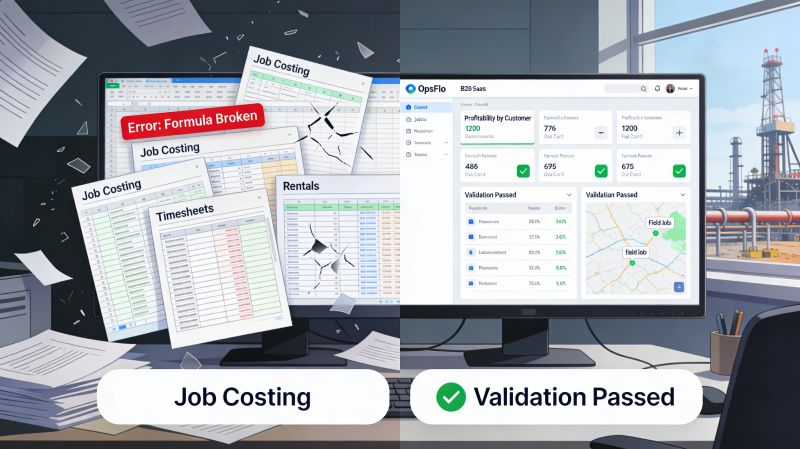
The Core Problem: The Haynesville shale is a different animal. Depths of 11,000 to 13,000 feet. High pressures. Hot temperatures. This is not a race to pump sand. This is a marathon of logistics where every hour of downtime costs you real money. Generic software built for the Permian or Bakken often fails here because it does not understand the rhythm of deep, fast wells. You need Haynesville field operations software that matches the intensity of the play.
## The Core Operational Breakdown: Why the Haynesville Punishes Slow Systems
You are not running a standard vertical well operation. The Haynesville requires massive horsepower. You are pumping at pressures that would rupture equipment in other basins. Your frac spreads run at 9,500 to 10,000 PSI. Your triplex mud pumps are working harder. Your drill pipe is longer, and your torque limits are tighter.
This creates a specific operational burden. When you run a 12,000 foot lateral with 45 to 50 stages, the margin for error in scheduling shrinks. A wireline unit that is late by two hours on a 15,000 foot well is not just a nuisance. It is a cascading failure that pushes the frac crew into overtime, delays the next stage, and burns diesel while everyone waits.
The field operations software you choose must handle three specific Haynesville realities.
First, it must manage the sheer volume of third-party services on location. You have the frac fleet, the wireline crew, the coil tubing unit, the sand haulers, and the water transfer pumps. Each one generates a ticket. Each ticket has line items for equipment, fluids, additives, and labor. If your software cannot handle 40 to 60 tickets per well per day without lag, you are losing money.
Second, it must account for the distance between the wellhead and the office. The Haynesville spans East Texas and Northwest Louisiana. Your operations office might be in Shreveport, but your well is 90 miles away in DeSoto Parish. Paper tickets that get faxed or scanned at the end of the day create a 24 to 48 hour billing delay. That delay is capital sitting in receivables.
Third, it must handle the rapid cycle time of the well. The Haynesville has some of the fastest drill out times in the industry. You can drill out a plug in 45 minutes. You can complete a stage in 20 minutes. When your cycle time is that fast, your data entry must be faster. Manual entry or spreadsheet tracking simply cannot keep pace with a crew that is pumping a stage every 30 minutes.
## The Real Financial Drain: Show the Math on Ticket Errors and DSO
Let us talk about the actual dollars, not the theory. The average oilfield service company in the Haynesville operates on thin margins. If your EBITDA margin is 18 percent, a single billing error can wipe out the profit on an entire job.
Consider the cost of a ticket error. A field ticket for a frac job might have 15 line items. One mistake, say a wrong pump rate or an incorrect additive volume, creates a variance of 2 percent on the invoice. On a $250,000 frac job, that is a $5,000 discrepancy. The operator will not pay it without a deduction. You will spend an hour of a billing clerk's time to research the dispute, call the field, and issue a credit memo. That hour costs you $45 in burden. The $5,000 deduction sits in dispute for 30 days. At a 10 percent cost of capital, that dispute costs you $41 in financing charges. Add it up: one error costs you over $5,000 in cash flow and margin. Now multiply that by the 10 to 15 errors you get per month across your fleet. That is $75,000 a month bleeding out of your business.
The bigger drain is Days Sales Outstanding (DSO). The industry average for oilfield services is 60 to 75 days. Why? Because the invoice is wrong, or the ticket is missing a signature, or the operator's system rejects it because the ticket number is duplicated. Every day you shave off that DSO is cash in your pocket.
Let me show you the arithmetic. Suppose your company does $18 million in annual revenue. That is $1.5 million in monthly billings. If you reduce DSO from 65 days to 45 days, you free up 20 days of cash. That is $1 million in working capital released. At a 10 percent annual interest rate, that is $100,000 in saved financing costs per year. That is not a rounding error. That is a full-time employee's salary plus benefits.
## Why Generic Solutions and Spreadsheets Fail in the Field
I have seen the Excel spreadsheets. I have seen the QuickBooks workarounds. I have seen the generic project management tools. They all fail for the same reason: they are not built for the chaos of a live well site.
A spreadsheet is a static document. The Haynesville is a dynamic environment. When the company man changes the pump schedule at 2:00 AM, your spreadsheet does not update. When the sand supplier delivers 40,000 pounds less than the ticket says, your spreadsheet does not catch it. When the wireline crew finishes two hours early and wants to leave, your spreadsheet does not generate the revised ticket for the extra standby time.
Generic field service software built for HVAC or plumbing fails because it does not understand the concept of a "ticket." It does not know what a choke manifold is. It does not know that a frac pump has a pump rate measured in barrels per minute. It does not know that a vacuum truck has a tare weight that must be verified on the scale ticket.
The result is that your field supervisors become data entry clerks. They spend 45 minutes at the end of each shift typing numbers into a tablet. That is 45 minutes they are not supervising the crew, not checking the iron, not watching the pressure gauges. That lost supervision time leads to safety incidents and equipment damage.
## Step-by-Step Operational Framework: How to Run a Digital Field Operation
You need a system that works from the moment the crew arrives on location to the moment the invoice is paid. Here is the framework I recommend for Haynesville operators.
**Step 1: Digital Dispatch with Basin Awareness.** Your software must know that a job in Carthage, Texas requires different equipment than a job in Shreveport, Louisiana. It must route the correct frac spread, the correct wireline unit, and the correct sand volume based on the well plan. It must flag if you are sending a pump that is rated for 2,500 horsepower to a well that requires 3,000 horsepower.
**Step 2: Live Ticket Creation at the Wellhead.** The field supervisor opens the app on a rugged tablet. The job is pre-populated with the purchase order number, the well name, and the operator's contract terms. The supervisor checks off the equipment as it arrives. He enters the actual pump start time and pump end time. He attaches a photo of the pressure chart. He captures the electronic signature of the company man before the crew leaves location.
**Step 3: Automated Verification Against Contract Rates.** This is where the money is saved. The software checks the ticket line items against the agreed rates in the contract. If the contract says the frac pump rate is $4,500 per hour, and the field supervisor enters $4,700, the software flags the discrepancy immediately. The supervisor corrects it on the spot, not 30 days later when the operator rejects the invoice.
**Step 4: Instant Transmission to the Back Office.** The ticket is sent to the office the moment it is signed. There is no waiting for the crew to drive back to the shop. There is no faxing. The billing clerk sees the ticket in the queue immediately. She reviews it, approves it, and sends it to the operator through the correct portal, whether that is PIDX, OpenInvoice, or Cortex.
**Step 5: Accelerated Billing Cycle.** Because the ticket is clean and verified, the invoice goes out the same day. The operator receives it in their system without errors. They approve it faster because there are no disputes. Your DSO drops from 65 days to 45 days or less.
## Field Case Study Breakdown: Exact Metrics from a Haynesville Completions Crew
Let me give you a concrete example. I worked with a frac service company running two spreads in the Haynesville. They were using paper tickets and a manual billing process. Their DSO was 71 days. Their ticket error rate was 8 percent. That means 8 out of every 100 tickets had a mistake that caused a payment delay.
They switched to a digital field operations system. Here are the exact metrics after 90 days.
Ticket error rate dropped from 8 percent to 1.5 percent. That is a 6.5 point improvement. On their monthly billing of $2.1 million, that eliminated $136,500 in disputed charges per month.
The time to create a ticket dropped from 25 minutes to 6 minutes. That saved 19 minutes per ticket. With an average of 35 tickets per day across both spreads, that is 665 minutes saved per day. That is 11 hours of field supervisor time returned to actual supervision.
DSO dropped from 71 days to 48 days. That is a 23 day improvement. On their $25 million annual revenue, that released $1.6 million in working capital. The company used that cash to purchase a new wireline unit without taking on debt.
The billing department reduced from three full-time clerks to one full-time clerk. The other two were reassigned to collections and customer service. The company saved $120,000 in annual payroll costs.
The total financial benefit in the first year was $412,000 in direct savings and working capital improvements. The software cost them $48,000. That is a return on investment of over 8 times in the first year.
## Implementation Checklist for Supervisors and Office Dispatch
You cannot just buy software and expect it to work. You need a disciplined rollout. Here is the checklist I use with operators in the Haynesville.
First, map your current ticket flow. Walk through one job from start to finish. Identify every handoff, every signature, every data entry point. You will find at least three places where data is re-entered manually. Those are your error points.
Second, clean your master data. Your equipment list, your crew list, your rate sheets, and your customer list must be accurate before you go live. Garbage in, garbage out. If your rate for a hot oil unit is wrong in the system, you will bill the wrong rate every time.
Third, train the field supervisors first, not the office staff. The supervisors are the ones who will make or break this. If they do not trust the system, they will not use it. Show them how it saves them time at the end of their shift. Show them how it prevents them from getting yelled at by the billing clerk for a bad ticket.
Fourth, run a parallel test for two weeks. Run the digital system alongside your paper process. Compare the tickets. You will find discrepancies. Fix them before you cut over fully.
Fifth, set a DSO target and track it weekly. Do not wait for the monthly financial review. The DSO number is a lagging indicator. You need to track the percentage of tickets that are sent to the operator within 24 hours of the job completion. That is your leading indicator.
Quick Math on Ticket Speed: If you invoice $1.5 million per month and you accelerate billing by 10 days, you free up $500,000 in cash. Use our ROI calculator to model your specific fleet size and revenue. It takes two minutes and gives you a defensible number for your next capital request.
## Frequently Asked Questions
**Question: What is the difference between Haynesville field operations software and a standard ERP system?**
An ERP system like NetSuite or SAP is a financial backbone. It tracks general ledger entries, payables, and receivables. It is not built to sit on a location in the middle of Caddo Parish and capture a wireline ticket in real time. Field operations software is built for the point of activity. It captures the operational data, verifies it against contracts, and then sends a clean, validated invoice to your ERP. You need both, but they serve different purposes. Trying to use an ERP in the field is like trying to drive a nail with a wrench. It is the wrong tool.
**Question: How long does implementation take for a typical Haynesville service company?**
A focused implementation takes 30 to 45 days. The first week is data cleanup and system configuration. The second week is field supervisor training and parallel testing. The third and fourth weeks are live operation with daily check-ins. The final two weeks are optimization, where you tune the contract rate tables and the approval workflows. The key is having a dedicated project champion on your side who has the authority to make decisions about process changes.
**Question: Will the software work if my crews are in a dead zone with no cell service?**
Yes. The software must have an offline mode. The field supervisor captures the ticket on the tablet, and the app stores it locally. When the tablet gets back to an area with cell service or Wi-Fi, the ticket syncs automatically. This is a non-negotiable requirement for the Haynesville, where large portions of the play have spotty coverage. You should test this during your pilot phase, not after you have rolled out to all your crews.
**Question: How does this handle the different ticket formats required by different operators?**
Every operator has their own format. One wants the ticket on their proprietary form. Another wants it submitted through OpenInvoice. A third wants a PDF emailed to a specific address. The software must have a template engine that lets you configure the output format for each customer. You set it up once, and the system remembers which format to use for which operator. This eliminates the manual reformatting that causes most billing delays.
## Clear Executive Takeaway
The Haynesville is a high pressure, high volume play that demands precision. Your field operations software must match that precision. If you are still running on paper tickets and spreadsheets, you are leaving hundreds of thousands of dollars on the table every year. The math is simple. Cleaner tickets mean faster payment. Faster payment means more working capital. More working capital means you can bid on more jobs and grow your fleet without borrowing money.
Do not buy a generic tool. Buy a system built for the way you actually work. A system that understands what a frac manifold is. A system that knows the difference between a wireline unit and a swab rig. A system that treats the ticket as the most important document in your business, because it is.
The operators who thrive in the Haynesville over the next five years will not be the ones with the biggest frac spreads. They will be the ones with the tightest back office. They will be the ones who can invoice faster, collect faster, and reinvest faster than their competitors.
Start by measuring your current DSO and your ticket error rate. Then talk to a vendor who understands the basin. If you want a concrete number for your specific operation,
request a revenue diagnostic. They will show you exactly where your cash is leaking and how much you can recover.
Your field supervisors are the best in the business. Give them the tools to match their skill. Your billing clerks are drowning in paper. Give them a system that eliminates the errors before they happen. Your CFO is watching the cash balance. Give them a reason to smile at the next board meeting.
The Haynesville does not wait for slow operators. The wells are deep, the pressures are high, and the competition is fierce. The difference between the leaders and the laggards is not the iron in the ground. It is the software in the office. Choose wisely. Choose a system built for the deep, fast wells of the Haynesville. Your bottom line will thank you.