


How To Speed Up Oilfield Invoicing Without Adding Office Staff
The hard truth: Your frac pumps are making money. Your office invoicing process is losing it. Every day a field ticket sits unapproved is a day your cash sits in someone else's account. This guide shows you exactly how to speed up oilfield invoicing without hiring another clerk.
The Core Operational Breakdown: Where Your Invoice Time Actually Goes
Ask any dispatcher in Midland or Williston how long it takes to close a job. They will tell you the field work ended three days ago, but the invoice is still bouncing between a pumper, a company man, and an AP clerk in Houston. That gap is not a paperwork problem. It is an operational leak.
To understand how to speed up oilfield invoicing, you must first break down the timeline. A typical service job for a wireline unit or a vacuum truck has five distinct stages. Each stage adds hours, and often days, to your billing cycle.
Stage one is data capture. The field crew writes down ticket numbers, pump hours, fluid volumes, and hand signatures. Stage two is physical transfer. That paper ticket sits in a glove box, then a truck cab, then a dispatcher's pile. Stage three is data entry, where someone types those handwritten numbers into an accounting system. Stage four is the approval chain. The operator's company man reviews the ticket against his own daily report. Stage five is submission and payment posting.
The average oilfield service company spends 40 minutes of manual labor per ticket across those stages. If you run 200 tickets a month, that is 133 hours of pure administrative work. That is one full-time employee doing nothing but chasing paper. And that does not count the rework when a ticket is rejected for a bad signature or a wrong pump rate.
The Real Financial Drain: Show Me the Math
Let us talk about Days Sales Outstanding, or DSO. The average oilfield services company carries a DSO of 55 to 65 days. The big operators pay on their terms, usually net 30 or net 45 from the date of a correct invoice. If your invoice is late or incorrect, you reset that clock.
Consider a pressure pumping company doing $2 million a month in revenue. If your DSO is 60 days, you have $4 million tied up in receivables. If you cut that DSO by just 12 days, you free up $800,000 in working capital. That is not theoretical. That is cash you can use to buy a spare triplex mud pump or pay down a line of credit.
The Cost of a Single Rejected Ticket:
Field labor to re-create the ticket: 2 hours at $45/hour = $90
Dispatcher time to track down the company man: 1 hour = $35
AP clerk time to re-submit and follow up: 1.5 hours = $45
Extended DSO on a $15,000 ticket for 10 extra days at 8% interest: $33
Total direct cost per rejection: $203
If 8% of your tickets get rejected, that is a tax on your revenue you never budgeted for.
There is also the hidden cost of disputes. A company man in the Eagle Ford might reject a ticket because the ticket shows 14 hours on location, but his daily drilling report shows 13.5. That 30-minute discrepancy becomes a 45-minute phone call, a revised ticket, and a 14-day delay in payment. Multiply that by every job in the Permian Delaware and you see the drain.
Why Generic Solutions and Spreadsheets Fail in the Field
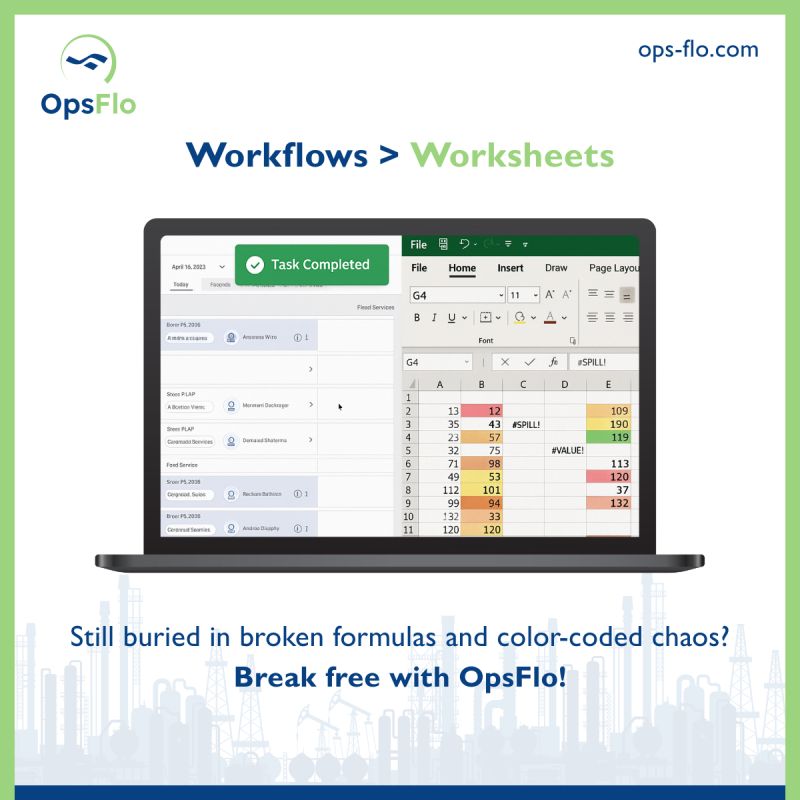
Most operators try to fix this with Excel templates or generic invoicing software. These tools work fine for a landscaping company. They fail in the oilfield because they do not understand the operational reality of a well site.
First, there is the connectivity problem. A swab rig in the Bakken might be 30 miles from the nearest cell tower. A generic cloud invoicing app requires a stable connection to log hours. When the connection drops, the crew goes back to paper. You are right back where you started.
Second, there is the signature problem. Operators require wet signatures or verified digital signatures from the authorized company representative. A generic tool that lets anyone click an approval button does not satisfy the operator's audit requirements. Your invoice gets kicked back.
Third, there is the data structure problem. Your invoice needs to map to specific cost codes, AFE numbers, and well IDs. A generic spreadsheet treats those as text fields. The operator's AP system treats them as mandatory data keys. If your ticket does not match the PO structure exactly, it fails validation on their end. You do not get paid.
The solution is not more office staff. The solution is operational technology that mirrors the field workflow. You need a system that captures data at the source, works offline, and syncs the moment a signal appears.
Step-by-Step Operational Framework to Speed Up Oilfield Invoicing
Here is the framework that works across the Permian, Haynesville, and every basin in between. It removes the manual handoffs that create delay and error.
Step 1: Digitize at the Point of Service, Not the Office
The moment the job is done, the ticket should exist in digital form. The wireline engineer logs the depth and the shot count on a tablet or rugged phone before the unit pulls off location. The vacuum truck operator logs the barrels picked up and the disposal well ID before he leaves the pad.
This is where digital field ticketing changes the game. The data is captured once, at the source, with dropdowns that prevent typos. No more illegible handwriting. No more transposing a 7 for a 1 on a pump rate.
Step 2: Automate the Approval Workflow
Once the ticket is digital, it needs to move through approval instantly. The system should route the ticket to the correct company man or operator representative automatically. It should send a push notification to their phone. If they do not respond in four hours, it escalates to the field superintendent.
You want to align with the operator's existing standards. Many large operators use PIDX or OpenInvoice for electronic invoicing. If your system can export a valid PIDX XML file, your invoice goes straight into their workflow without manual re-keying on their side. That alone can cut approval time by three days.
Step 3: Integrate Directly with Your Accounting System
The approved ticket should flow directly into your ERP or accounting software. No re-typing. No CSV exports that require manual mapping. The invoice is generated, posted, and sent to the operator on the same day the ticket is approved.
This integration is the difference between a 15-day billing cycle and a 2-day billing cycle. You do not need a bigger accounting team. You need a system that removes the data entry bottleneck entirely.
Step 4: Standardize Your Ticket Fields
Sit down with your top five operators and ask for their exact invoice requirements. Do they need a separate line for fuel surcharge? Do they require the AFE number on every line item? Do they want the ticket signed by the toolpusher or the company man?
Build those requirements into your digital ticket template. When the field crew logs the job, the mandatory fields are enforced. The ticket cannot be submitted unless the AFE number is correct and the signature is captured. This prevents the rejection before it happens.
Permian Field Case Study: Exact Metrics from a Midland Pressure Pumping Company
Let us look at a real example. A pressure pumping company operating in the Midland Basin runs three frac spreads. Each spread completes roughly 15 stages per month. Between pump down, acid, and wireline support, they generate 45 invoices per spread per month. Total: 135 invoices monthly.
Before the process change, their billing cycle looked like this. The frac van operator printed a ticket at the end of each stage. The company man signed a paper copy. The ticket went into a folder. At the end of the crew's 14-day hitch, the folder went to the district office. A billing clerk spent two full days entering 45 tickets into QuickBooks. The invoices went out on day 16 after the work. The operator paid on net 30 from invoice date. Total cash cycle: 46 days.
They switched to a digital ticketing system with offline capability. The frac van operator now logs the stage data on a tablet inside the van. The company man approves it on his phone before the next stage begins. The ticket syncs to the office when the van gets within cell range, usually within the hour.
The results after 90 days were measurable. Invoice generation time dropped from 16 days to 2 days. The billing clerk was reassigned to collections, which improved follow-up on aged receivables. Ticket rejection rate fell from 9% to 1.5% because the mandatory fields eliminated data entry errors.
The financial impact was substantial. Their DSO dropped from 58 days to 44 days. On $2.3 million in average monthly revenue, that freed up $1.07 million in working capital. They used the cash to take advantage of a prompt payment discount from their sand supplier, saving an additional $18,000 per month.
The Math on Staff Avoidance:
Previous process: 135 invoices x 40 minutes manual handling = 90 hours per month.
That is 2.25 weeks of one person's time.
New process: 135 invoices x 5 minutes review = 11.25 hours per month.
Net savings: 78.75 hours per month, or roughly $2,750 in direct labor.
More importantly, you did not need to hire a second billing clerk when you added your fourth frac spread.
Implementation Checklist for Supervisors and Office Dispatch
You cannot flip a switch and change your billing process overnight. Use this checklist to roll out the change without disrupting active operations.
- Week 1: Audit your current ticket flow. Count how many tickets you processed last month. Measure the average time from job completion to invoice submission. Identify the top three reasons for rejections.
- Week 2: Define your mandatory data fields. Talk to your three biggest operators. Get their exact requirements for AFE numbers, cost codes, and signature authority. Build a template that enforces these fields.
- Week 3: Pilot with one crew. Pick your most tech-comfortable crew in the Delaware Basin. Run 20 tickets through the digital system. Track the time from job end to approval. Compare it to your historical average.
- Week 4: Train the office dispatch team. Your dispatchers need to know how to monitor the approval queue and escalate stuck tickets. They become exception handlers, not data entry clerks.
- Week 5: Expand to all crews. Roll out the system basin by basin. Start with the Permian, then move to the Eagle Ford and Haynesville.
- Week 6: Review the metrics. Look at your DSO, your rejection rate, and your invoice cycle time. Set a target for the next quarter.
During the rollout, keep your paper system as a backup for the first two weeks. This reduces the risk of a missed invoice while crews learn the new tool. But do not let the paper system become the default. Force the digital submission by making it the only way to get paid on time.
Frequently Asked Questions
Q: What if my crews are not tech-savvy? They still struggle with email.
This is the most common objection. The solution is not training them on a complex ERP. The solution is an interface designed for a gloved hand in a dusty cab. If a field ticket app looks like a text message thread, your crew will use it. If it looks like a spreadsheet, they will reject it. Choose a tool with large buttons, voice-to-text for notes, and photo capture for the signed ticket. The learning curve is under 15 minutes.
Q: Will operators accept digital signatures instead of wet ink?
Yes, provided the system captures a verifiable audit trail. The operator wants to know who signed, when they signed, and that the signature was not forged. A digital signature with a timestamp and GPS location is actually stronger evidence than a wet signature on a paper ticket that could be lost or altered. Most major operators already use digital approval workflows internally. They prefer receiving digital tickets because it reduces their own data entry burden.
Q: Does this work for small operators with one vacuum truck?
Absolutely. The economics are different, but the principle is the same. If you run 30 tickets a month and your DSO is 60 days, you are carrying two months of revenue in receivables. For a single vacuum truck generating $40,000 a month, that is $80,000 outstanding. Cutting your invoice cycle from 10 days to 2 days gets you paid faster. You might only save 10 hours a month of admin time, but you also save the stress of chasing payments while you are trying to run a pump.
Q: How does this connect to the operator's payment portal like OpenInvoice or Cortex?
Your digital ticketing system should be able to export a file format that matches the operator's portal requirements. If you are sending a PDF attachment manually to an AP clerk, you are still in the slow lane. You want a system that can generate the correct XML or EDI format automatically. That way, your invoice posts directly into the operator's approval queue without a human touching it on their side. This is the single biggest lever for faster payment.
Clear Executive Takeaway
The bottleneck in your oilfield business is rarely the iron in the ground. It is the paper in the office. Every day you wait to invoice is a day you finance your customer's operations with your own cash.
You do not need to hire another billing clerk to fix this. You need to change the workflow so the data is captured once, at the source, in a format that your customer can approve instantly. The technology exists. The question is whether you will adopt it before your competition does.
Start by measuring your current DSO and your ticket rejection rate. Then run the numbers through our ROI calculator to see exactly what a 10-day improvement is worth to your operation.
If you want a specific plan for your basin and your equipment spread, request a revenue diagnostic. We will map your current ticket flow and show you where the days are leaking.
The operators who figure out how to speed up oilfield invoicing will have the cash to bid on the next pad. The ones who do not will be watching from the sidelines. Choose which side you want to be on.
For a deeper look at the specific tools and workflow, explore accelerated oilfield billing solutions designed for the field.
No comments yet
Be the first to share your thoughts.
Leave a Reply
Comments are disabled on the shared-hosting build. If you want to respond to this article, email info@ops-flo.com and mention "How To Speed Up Oilfield Invoicing Without Adding Office Staff".
Contact OpsFlo