


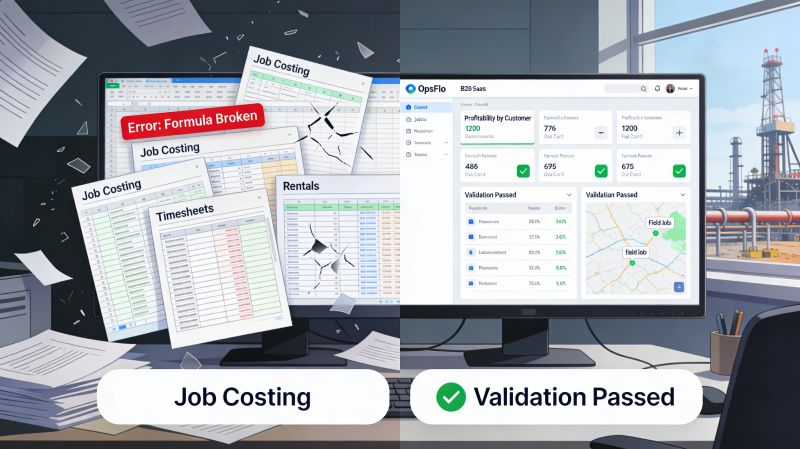
Oilfield Software Vs Spreadsheets: What Breaks First At Scale
The question of oilfield software vs spreadsheets is not about features. It is about the moment your operation outgrows the tool. That moment arrives when a pumper in the Permian Delaware hands you a ticket with a tare weight error, and your dispatcher in Midland has to call three vendors to reconcile it. The spreadsheet did not cause the error. It just made the error invisible until the invoice hit your desk 45 days later.
The Core Operational Breakdown: Why Paper and Excel Fail in the Field
Every oilfield service company starts the same way. A swab rig crew finishes a job. The toolpusher scribbles the hours, the water volume, and the truck numbers on a carbon copy ticket. That ticket goes to the office. Someone types it into Excel. Someone else emails it to the operator. Then you wait.
The wait is where the money leaks. Operators like ExxonMobil, Chevron, and ConocoPhillips run their own approval workflows through OpenInvoice or Cortex. If your ticket has a missing signature, a wrong AFE number, or a unit number that does not match their master data, the system rejects it. The rejection does not come back to you automatically. It sits in a queue. Your invoice gets pushed to the next cycle. That is a 30 to 60 day delay on cash that you already spent on diesel, crew wages, and frac tank rentals.
The oilfield software vs spreadsheets debate misses the point if you only look at data entry speed. A good clerk can type a ticket into Excel in three minutes. That is not the bottleneck. The bottleneck is the reconciliation loop. When the operator disputes a line item, someone has to pull the original ticket, call the field, and verify the math. With spreadsheets, that process is manual and slow. With oilfield software, the digital field ticket is the source of truth, and the approval history is attached to the record.
The Real Financial Drain: Show the Math on Revenue Leakage
Let us put concrete numbers on this. Assume you run five swab rigs in the Midland Basin. Average ticket value is $4,800. You run 20 tickets per week per rig. That is 100 tickets a week, or roughly 5,200 tickets a year. Your gross revenue is just under $25 million.
Industry benchmarks for first-pass approval rates on oilfield service tickets run between 70 and 85 percent. That means 15 to 30 percent of your tickets get kicked back. Let us be conservative and say 20 percent. That is 1,040 tickets a year that require rework.
Each rework cycle costs you two things. First, the administrative labor. Your billing coordinator spends an average of 25 minutes per rejected ticket chasing down the error, calling the field, and resubmitting. At $35 per hour fully loaded, that is $14.58 per ticket. Multiply by 1,040 tickets and you have $15,163 in pure administrative waste.
Second, and far more damaging, is the delay on the other 80 percent of your receivables. If your average invoice is $4,800 and you have 4,160 clean tickets, that is roughly $20 million in gross billings. A 15 day delay on that cash flow at a 9 percent cost of capital is $73,972 in hidden financing costs. Combine the two and you are losing nearly $90,000 a year on a $25 million operation. That is a 0.36 percent margin hit that you never see because it is spread across dozens of small events.
The arithmetic of revenue leakage:
- 5,200 tickets per year at $4,800 average = $24.96M gross
- 20% rejection rate = 1,040 rejected tickets
- 25 minutes admin time per rejection at $35/hr = $15,163 lost
- 15 day delay on $20M clean billings at 9% cost of capital = $73,972 lost
- Total annual leakage on a modest 5 rig fleet: $89,135
That number only grows when you add vacuum truck operations, frac water hauling, or wireline services. Each additional service line adds complexity. Each complexity adds a new place for a spreadsheet formula to break or a ticket to go missing. The oilfield software vs spreadsheets comparison is really a comparison of compounding errors versus compounding accuracy.
Use this ROI calculator to run the numbers against your own fleet size and ticket volume. The output will surprise you.
Why Generic Solutions and Spreadsheets Fail in the Field
The failure modes of spreadsheets are not random. They are structural. A spreadsheet has no memory of the physics of your operation. It does not know that a frac manifold has 14 individual valves that each need to be tracked. It does not know that a triplex mud pump requires a specific pressure rating before you can bill for it. It only knows the cells you type into it.
Consider the common problem of unit number errors. Your dispatcher sends a vacuum truck to a wellsite in the Bakken. The truck returns with a ticket that has the wrong unit number. The pumper wrote "VAC-12" but the truck that actually showed up was "VAC-21". The field ticket is signed. The operator's gate log shows VAC-21 on site. The spreadsheet has VAC-12. The discrepancy does not surface until the operator's audit team compares the two records 60 days later. Now you have a chargeback.
A spreadsheet cannot catch this error because it has no validation rules tied to your actual equipment master list. Oilfield software, when configured properly, restricts the unit number field to the active fleet. The pumper cannot select a truck that was not dispatched. The error becomes impossible, not just unlikely.
The second structural failure is version control. You have a master spreadsheet on the office server. Your field supervisor has a copy on his laptop. Your company man has a third version on his tablet. Someone updates the pricing sheet on the server. The supervisor does not get the memo. He bills the old rate for three weeks. The operator catches it and rejects every single ticket from that period. That is not a data entry problem. That is a communication infrastructure problem.
The third failure is the human one. Spreadsheets are blank canvases. They offer no guidance. A new dispatcher in the Haynesville does not know that the operator in that area requires a separate ticket for each stage of the frac job. He combines them into one. The operator rejects it. The learning curve costs you time and money on every new hire.
Step-by-Step Operational Framework for Going Digital
Moving from spreadsheets to oilfield software is not a software installation project. It is an operational change. The framework below has worked for service companies in the Eagle Ford, the Permian, and the DJ Basin. Follow it in order.
Step 1: Map Your Current Ticket Flow
Draw the path of a single ticket from the wellsite to payment. Identify every handoff. Every handoff is a place where information degrades. Count the touches. If a ticket touches more than four people before it becomes an invoice, you have a problem.
Step 2: Standardize Your Master Data
Before you move anything into software, clean your equipment list, your pricing sheets, and your customer codes. A digital system will enforce consistency. If your master data is wrong, the software will just make the wrong data consistent. Fix the source first.
Step 3: Digitize the Field Capture
The goal is to eliminate the paper ticket entirely. Give your pumpers and toolpushers a mobile device with digital field ticketing. The form should match the operator's required format exactly. If the operator wants a specific signature block, put it in the digital form. If they want a photo of the gauge reading, make it a required field.
Step 4: Automate the Approval and Submission Loop
Once the field ticket is signed digitally, the software should route it to the operator's system automatically. This is where you see the biggest reduction in days sales outstanding. You cut out the manual email step and the waiting period. The ticket goes from the field to the operator's approval queue in minutes, not days.
Step 5: Measure the Rejection Rate Weekly
Track your first-pass approval rate every week. If it drops below 90 percent, investigate immediately. The most common causes are new operator requirements, pricing changes, or equipment master data errors. Catch them early and correct them in the system, not in a spreadsheet.
Permian Field Case Study: Exact Metrics from a Midland Operator
A well servicing company in Midland, Texas ran 14 swab rigs across the Permian Delaware and Midland basins. They operated entirely on paper tickets and Excel for five years. Their billing team of three coordinators handled roughly 280 tickets per week.
The baseline metrics were sobering. First-pass approval rate sat at 74 percent. Average invoice cycle time, from field completion to operator approval, was 18 days. Days sales outstanding ran at 52 days. The finance team estimated they were carrying $1.8 million in receivables older than 60 days.
They implemented a digital field ticketing system over a six week period. The first two weeks were dedicated to cleaning up the equipment master list and aligning their pricing structure with the operators' contract terms. The next four weeks were a phased rollout, starting with one district and expanding to all 14 rigs.
The results after 90 days were measurable. First-pass approval rate climbed to 94 percent. The remaining 6 percent of rejections were almost entirely due to operator-side data entry errors, not field mistakes. Invoice cycle time dropped from 18 days to 3 days. Days sales outstanding fell from 52 days to 38 days.
The financial impact was direct. The 14 day reduction in DSO on their average monthly billing of $2.1 million freed up approximately $980,000 in working capital. At their 8 percent cost of capital, that was worth $78,400 annually. The reduction in rejected tickets saved an estimated 60 hours of billing coordinator time per month, which they redirected to chasing down the remaining old receivables.
Case study summary:
- Before: 74% first-pass approval, 18 day invoice cycle, 52 day DSO
- After: 94% first-pass approval, 3 day invoice cycle, 38 day DSO
- Working capital freed: $980,000
- Annual value of DSO reduction: $78,400
- Billing team hours saved: 60 per month
If you suspect your operation has similar leakage, request a revenue diagnostic to get a precise read on your own numbers.
Implementation Checklist for Supervisors and Office Dispatch
The oilfield software vs spreadsheets decision is not made in the boardroom. It is made in the field, by the people who have to use the system every day. If the toolpusher does not trust it, he will find a way around it. Here is the checklist that gets buy-in from the field and the office.
- Involve the field supervisor in the software selection. Ask him what information he needs to capture at the wellsite. He knows the operator requirements better than the office does.
- Test the mobile app on a real job in poor connectivity. The Permian has dead zones. The Bakken has dead zones. If the app cannot cache tickets offline and sync later, it will fail.
- Run a parallel process for two weeks. Keep the paper tickets and the spreadsheet as the backup. Compare the digital tickets against the paper ones daily. Reconcile every discrepancy before you switch off the old system.
- Train the office dispatch team on the operator's approval portal. Cortex and OpenInvoice have their own quirks. Your billing team needs to understand how the operator's system processes your digital submission.
- Set a hard cutover date. Do not let the paper system linger. The moment you have two weeks of clean parallel data, cut over completely. A hybrid system creates confusion and duplicate work.
- Review the rejection report every Monday. Make it a standing agenda item. If the rejection rate climbs above 5 percent, stop and fix the root cause before it becomes a habit.
The goal is not to eliminate every error. The goal is to make errors visible within 24 hours instead of 60 days. A visible error is cheap to fix. An invisible error is expensive.
Frequently Asked Questions
Will oilfield software work without reliable internet at the wellsite?
Yes, if you choose the right system. Look for offline-first architecture. The field app should save the ticket locally on the device and sync automatically when the user gets back to coverage. Do not accept a system that requires a live connection to save a ticket. That will fail in the Delaware basin just as surely as it will fail in the remote areas of the Haynesville.
How long does it take to move from spreadsheets to oilfield software?
A focused implementation takes four to eight weeks. The first two weeks are for data cleanup and process mapping. The next two to four weeks are for pilot testing with one crew or one district. The final two weeks are for full rollout and training. The biggest variable is the quality of your master data. If your equipment list and pricing tables are a mess, expect the timeline to stretch.
What is the difference between oilfield software and a generic CRM or ERP system?
A generic ERP is built for manufacturing or retail. It does not understand a frac ticket, a swab rig hour, or a vacuum truck load. Oilfield software is built around the specific workflow of field service operations. It understands that a ticket has to match an AFE, that a pumper has to certify a water volume, and that an operator has specific approval rules. That domain knowledge is what drives the higher first-pass approval rate.
Does switching to oilfield software guarantee faster payment from operators?
It guarantees that your tickets are submitted correctly and immediately. It does not guarantee that the operator pays on time. What it does is remove your internal delays as the excuse. If your invoice is clean and submitted on day one, you have the right to demand payment on the operator's contractual terms. If you submit on day 18 because of manual processing, you have given the operator a reason to delay. The software puts the pressure where it belongs, on the payer, not on your own process.
Executive Takeaway
The oilfield software vs spreadsheets argument is not about technology preference. It is about the cost of operational blindness. Spreadsheets are fine when you have one rig, one operator, and one pricing model. The moment you scale to multiple basins, multiple service lines, and multiple operators with different approval rules, the spreadsheet becomes a liability.
The numbers are clear. A 20 percent ticket rejection rate on a $25 million operation costs you nearly $90,000 a year in hidden waste. A 14 day reduction in DSO on a $2 million monthly billing is worth almost $80,000 annually. These are not rounding errors. They are the difference between a profitable year and a break-even year.
You do not need to replace your entire operation overnight. You need to fix the ticket flow first. That is where the leakage starts and where the recovery is fastest. Look at accelerated oilfield billing to see how the submission loop shortens. Then look at the revenue leakage analysis to understand where your specific gaps are.
The field is tough. The operators are demanding. The margins are thin. You cannot afford to run your business on a tool that
No comments yet
Be the first to share your thoughts.
Leave a Reply
Comments are disabled on the shared-hosting build. If you want to respond to this article, email info@ops-flo.com and mention "Oilfield Software Vs Spreadsheets: What Breaks First At Scale".
Contact OpsFlo