

Predictive Maintenance Software: Catching Failures Before They're Expensive
The difference between a profitable month and a losing month in the oilfield often comes down to one thing: whether your iron is running or down. Predictive maintenance software is the tool that keeps your pumps turning and your wireline units spooling. It does not guess. It does not hope. It uses data from your equipment to tell you exactly when a part will fail, so you can fix it on your schedule, not the breakdown's schedule.
Hook and The Core Operational Breakdown
You run a frac crew in the Midland Basin. Your triplex pump is pushing 15,000 psi. The fluid end is taking a beating. You know the valves and seats are wearing, but you do not know how much wear is left. You run it until it fails. When it fails, you lose a day of pumping. That day costs you $180,000 in spread rate alone, before you pay for the replacement parts and the overtime for the maintenance crew.
That is the old way. The reactive way. The way that keeps your CFO awake at night.
Predictive maintenance software changes that equation. It monitors vibration, temperature, pressure differentials, and run hours on your critical assets. It learns the normal operating envelope for each piece of equipment. When the data drifts outside that envelope, the software flags it. You get a warning days or weeks before the catastrophic failure. You schedule the repair during your planned downtime, you order the parts ahead of time, and you keep your crew working.
This is not a theoretical concept. It is working today in the Permian, the Bakken, and the Haynesville. Operators who use predictive maintenance software report reductions in unplanned downtime of 30 to 50 percent. They extend the life of their equipment by catching small problems before they become big ones. They cut their parts inventory because they no longer stock parts for every possible failure mode. They know exactly what is going to fail and when.
The core operational breakdown is simple. You have three types of maintenance. Reactive maintenance means you fix it after it breaks. Preventive maintenance means you fix it on a fixed schedule, whether it needs it or not. Predictive maintenance means you fix it right before it breaks, based on the actual condition of the equipment. The third option is the most cost effective, and it is the one that most oilfield operators have not fully adopted.
The Real Financial Drain: Show the Math
Let me show you the numbers. They are not pretty, but they are real. A single workover rig in the Eagle Ford costs about $25,000 per day to run. If that rig goes down for 48 hours because a swivel failed, you have lost $50,000 in rig time. You also have a crew sitting in the man camp getting paid. You have a service company billing you standby time. The company man is calling your dispatcher every hour asking when you will be back online.
Now multiply that by the number of breakdowns you have in a year. If you run five workover rigs and each one has four unplanned failures per year, that is twenty failures. At an average of 24 hours of downtime each, you have lost 480 hours. At $25,000 per day, that is $500,000 in lost revenue. That is the direct cost. It does not include the cost of the replacement parts, the emergency freight charges, or the overtime you paid your mechanics to work through the night.
The Arithmetic of Downtime
- One frac pump failure: 12 hours of NPT at $15,000 per hour spread rate equals $180,000 lost
- One wireline unit down: 8 hours at $8,000 per hour equals $64,000 lost
- One vacuum truck transmission failure: 3 days in the shop equals $4,500 in lost revenue plus $2,800 in rental replacement
- One top drive failure on a drilling rig: 36 hours at $30,000 per day equals $45,000 lost
Add these up across your fleet and you will see that unplanned failures are not an operating cost. They are a direct reduction of your profit margin.
The other financial drain is inventory. When you run reactive maintenance, you stock parts for every conceivable failure. You have valve seats for pumps that do not need them yet. You have bearings for motors that are running fine. You have $200,000 tied up in parts that sit on a shelf collecting dust. Predictive maintenance software tells you exactly which parts you need and when you will need them. You can order just in time. You reduce your inventory carrying cost by 20 to 30 percent.
There is also the cost of premature replacement. Preventive maintenance schedules often replace parts that still have useful life. If you change the fluid end on a frac pump every 500 hours because that is the schedule, but the data shows the fluid end is only 60 percent worn at 500 hours, you are throwing away 40 percent of the part's life. Over a year, that is thousands of dollars in unnecessary parts on every pump you own.
Why Generic Solutions and Spreadsheets Fail in the Field
I have seen operators try to manage maintenance with spreadsheets. They have a column for hours, a column for last service date, and a column for notes. It works for about three pieces of equipment. When you have thirty vacuum trucks, twelve frac pumps, eight wireline units, and a fleet of support vehicles, the spreadsheet becomes unmanageable. Data gets entered late or not at all. The person who maintains the spreadsheet leaves the company and takes the knowledge with them.
Generic maintenance software from the manufacturing world does not work either. It is built for stationary equipment in a controlled environment. It does not understand the oilfield. It does not know that your equipment runs in 110 degree heat in the summer and minus 20 degrees in the winter. It does not know that your equipment vibrates differently when it is on location versus when it is being trucked down the highway. It does not know that a frac pump running at 15,000 psi wears differently than the same pump running at 8,000 psi.
The oilfield is a harsh environment. Your equipment is subject to dust, mud, salt water, and extreme temperature swings. It is operated by different crews on different shifts. It is moved from location to location, often without proper shutdown procedures. A generic system cannot account for these variables.
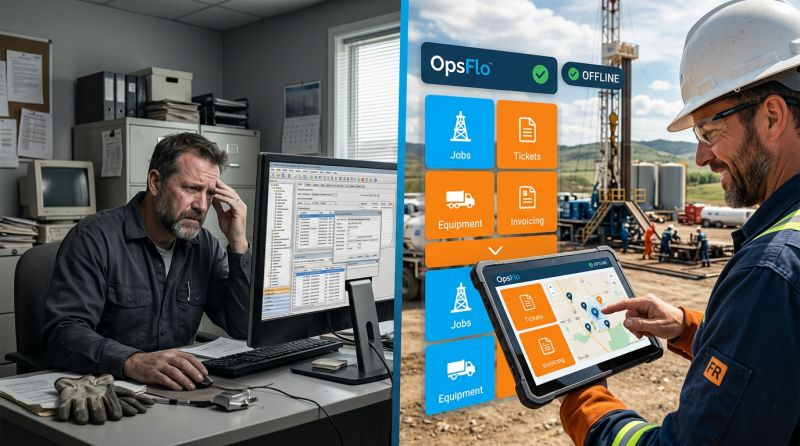
What you need is predictive maintenance software built for oilfield operations. It must integrate with your field ticketing system so that when a pumper closes a ticket, the hours on that equipment are automatically updated. It must be accessible from a tablet in the cab of a truck, not just from a desktop in the office. It must send alerts to the right person, whether that is the toolpusher on location or the maintenance coordinator in the office.
The other failure of generic systems is that they do not connect maintenance data to financial data. When your pump goes down, the software should tell you not just that the pump is down, but what that downtime costs you in lost revenue and what the repair will cost. That connection between operations and finance is what makes the difference between a maintenance tracking tool and a profit protection system.
Step-by-Step Operational Framework
Implementing predictive maintenance software in your oilfield operation requires a clear framework. Here is how to do it right.
Step 1: Identify Your Critical Assets
You cannot monitor everything at once. Start with the equipment that causes the most financial damage when it fails. For most operators, that means your frac pumps, your top drives, your wireline units, and your swab rigs. These are the assets where one failure stops the entire operation. Rank them by the cost of downtime. The highest cost assets get the earliest attention.
Step 2: Define Your Data Collection Points
Every piece of equipment has telltale signs of wear. For a triplex pump, it is vibration on the fluid end and temperature on the power end. For a top drive, it is torque fluctuation and gearbox temperature. For a wireline unit, it is drum speed variation and hydraulic pressure drops. Work with your mechanics to define the specific data points that indicate wear for each asset type. If you do not have sensors on the equipment, start with manual data entry. Your operators can log hours, pressures, and temperatures at the end of each shift. The software will still find patterns.
Step 3: Establish Your Baseline
The software needs to learn what normal looks like for your equipment. This takes time. Collect data for 30 to 60 days before you expect the software to make accurate predictions. During this period, continue your existing maintenance schedule. The software is building its understanding of your equipment's operating envelope.
Step 4: Set Your Alert Thresholds
You do not want alerts for every minor fluctuation. That creates alert fatigue and your crew will start ignoring the warnings. Set thresholds at the point where a problem is developing but before it becomes critical. For example, if normal vibration on your frac pump is 2.0 mm/s, set the warning at 3.5 mm/s and the critical alert at 5.0 mm/s. The warning gives you time to plan. The critical alert means act now.
Step 5: Integrate with Your Work Order System
When the software flags a potential failure, it should automatically generate a work order. The work order goes to your maintenance coordinator. The coordinator assigns it to a mechanic. The mechanic orders the parts. The parts arrive before the failure. The repair happens during scheduled downtime. This workflow is where the real savings happen.
Step 6: Review and Refine Monthly
Once a month, sit down with your maintenance team and review the predictions. Which ones were accurate? Which ones were false alarms? Which failures did the software miss? Use this information to refine your thresholds and your data collection points. The software gets smarter every month you use it.
Permian Field Case Study: The Numbers That Matter
Let me walk you through a real scenario from a frac service company operating in the Delaware Basin. This company runs six frac spreads, each with five triplex pumps. They were experiencing an average of one unplanned pump failure per spread every 45 days. Each failure cost them 14 hours of NPT. The company man was not happy. The customer was threatening to take their work to a competitor.
They implemented predictive maintenance software on their pump fleet. The software monitored vibration, discharge pressure, and fluid end temperature on all thirty pumps. Within the first 60 days, the software flagged three pumps that were showing abnormal vibration patterns on the fluid end. The maintenance team inspected those pumps and found cracked valve seats that were about to fail catastrophically.
They replaced the valve seats during planned downtime between stages. Each repair took four hours. The total cost of the parts was $18,000. The total cost of the planned downtime was zero, because the pumps were not needed during those four hours anyway.
If those pumps had failed during a pumping stage, the cost would have been different. Each failure would have caused 14 hours of NPT. At a spread rate of $180,000 per hour, that is $2.52 million per failure. Three failures would have been $7.56 million in lost revenue. The predictive maintenance software caught the problem for $18,000 in parts and zero lost time.
The Delaware Basin Math
- Before predictive maintenance: 1 failure per spread every 45 days, 14 hours NPT per failure
- Annual cost of failures: 6 spreads x 8 failures per year x 14 hours x $180,000 per hour equals $120.96 million
- After predictive maintenance: 3 failures caught in first 60 days, repaired in planned downtime
- Annual cost after implementation: less than $500,000 in parts and labor
- Net savings: over $120 million in avoided NPT
That is an extreme example because of the high spread rate on frac operations. But the principle applies to every segment of the oilfield. A wireline company running six units in the Bakken will see the same pattern. A vacuum truck operator running twenty trucks in the Permian will see the same pattern. The numbers scale with the cost of your equipment and the cost of your downtime.
The company also saw a reduction in their parts inventory. Before predictive maintenance, they stocked complete fluid ends for every pump in the fleet. That was $1.2 million in inventory. After six months of data, they knew exactly which parts were likely to fail and when. They reduced their inventory to $400,000. That freed up $800,000 in working capital. At 10 percent cost of capital, that is $80,000 per year in interest savings alone.
Implementation Checklist for Supervisors and Office Dispatch
If you are ready to implement predictive maintenance software, here is your checklist. Print it. Post it in the dispatch office. Go through it item by item.
- Inventory your critical assets. List every frac pump, top drive, wireline unit, swab rig, and vacuum truck you own. Include the asset ID, the year, and the current hours.
- Identify your failure history. Pull your work orders from the last 12 months. Which assets failed most often? What was the average cost of each failure? What was the average downtime?
- Calculate your cost of downtime. For each asset type, determine the hourly cost of that asset being down. Include lost revenue, crew wages, and standby charges from other contractors.
- Choose your data collection method. If your equipment has sensors, connect them to the software. If not, set up a simple process for operators to log hours and key operating parameters at the end of each shift.
- Set your alert thresholds. Start conservative. You want to catch problems early. You can adjust the thresholds after you have a few months of data.
- Train your maintenance team. They need to understand that the software is a tool to help them do their jobs better, not a replacement for their expertise. The software tells them where to look. They confirm the diagnosis.
- Integrate with your dispatch. When a piece of equipment is flagged for maintenance, your dispatcher needs to know so they can schedule the repair during downtime. This is where the coordination between office and field happens.
- Connect to your financial reporting. The software should show you the cost of each failure and the savings from each prediction. This data is what you will use to justify the investment to your CFO.
- Review monthly. Set a recurring meeting on the first Monday of every month. Review the predictions, the actual failures, and the cost savings. Adjust your thresholds and your processes.
The field supervisor and the office dispatch must work together on this. The supervisor knows the equipment. The dispatcher knows the schedule. The software connects the two. Without the software, the supervisor might know a pump is running rough, but the dispatcher schedules it for the next job anyway because there is no time to fix it. With the software, the dispatcher sees the warning and schedules the repair during a gap between jobs.
Frequently Asked Questions
How long does it take to see results from predictive maintenance software?
You will see initial results within the first 30 to 60 days. The software needs time to establish a baseline for your equipment. But once that baseline is set, the predictions start flowing. Most operators see their first caught failure within the first two months. The full financial impact becomes clear after six months, when you have enough data to compare your downtime before and after implementation.
Do I need sensors on all my equipment to use predictive maintenance software?
No. Sensors are ideal, but they are not required. You can start with manual data entry. Your operators log hours, pressures, temperatures, and any unusual observations at the end of each shift. The software analyzes this data and finds patterns. As you replace equipment or add new assets, you can install sensors on the most critical units. Many operators start with manual entry on their existing fleet and add sensors on new purchases.
What is the difference between preventive and predictive maintenance?
Preventive maintenance follows a fixed schedule. You change the oil every 250 hours whether it needs it or not
No comments yet
Be the first to share your thoughts.
Leave a Reply
Comments are disabled on the shared-hosting build. If you want to respond to this article, email info@ops-flo.com and mention "Predictive Maintenance Software: Catching Failures Before They're Expensive".
Contact OpsFlo