


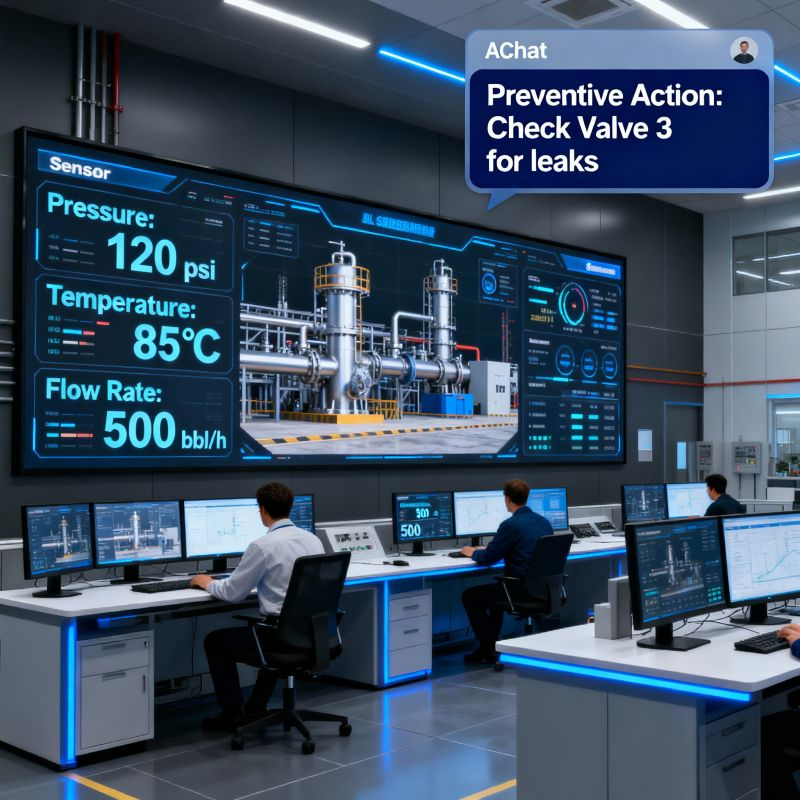
Safety Management Software Oilfield Sites Use To Catch Risk Before It Happens
The blunt truth: In the Permian Basin, a single H2S near-miss on a wireline unit can cost you $45,000 in non-productive time (NPT) before the company man even signs the ticket. You are not paying for software. You are paying to avoid the domino effect of a dropped wrench, a missed JSA, and a burned pump.
The Core Operational Breakdown: Why Safety Management Software Oilfield Supervisors Trust Is Not Optional
You run a swab rig crew in the Delaware Basin. The toolpusher has one eye on the brake and one eye on the wireline spool. The pumper is checking the separator pressure. The dispatcher in Midland is trying to route a vacuum truck through a rain-soaked lease road. Everyone is moving. Nobody is looking at the same piece of paper.
That is the problem. Safety management software oilfield operations need does not live in a binder on the dash of a F-350. It lives in the flow of data between the frac manifold, the tank battery, and the back office. When you digitize the observation, the hazard ID, and the corrective action, you stop reacting to the accident report and start intercepting the condition that causes it.
Consider the arithmetic of a typical 10-well pad in the Eagle Ford. You have 14 subcontractors on location. Each has their own safety protocol. The company man demands a daily JSA. Your foreman collects them via text message photos. Those photos sit in a phone gallery. Nobody reads them. The risk is not the drilling. The risk is the communication gap between the guy holding the tongs and the guy approving the AFE.
A proper digital system centralizes that observation. It forces a timestamped record. It creates an audit trail that survives crew changes and pump failures. When the inspector from the Railroad Commission asks for your last 30 days of hazard assessments, you do not scramble. You pull the report. That is the difference between a $2,500 fine and a $25,000 fine for documentation failure.
The Real Financial Drain: Show Me the Math on Incident Costs
Let me give you the breakdown that makes CFOs wince. The industry average for a recordable injury in oil and gas extraction is roughly $92,000 in direct costs. That is medical, legal, and administrative. But the indirect costs, the ones that hit your cash flow statement, are four to ten times that number. That is the lost rig time, the crew turnover, the insurance premium spike, and the reputational damage with the operator.
The NPT Calculation: A single dropped pipe incident in the Haynesville can shut down a triplex mud pump for 6 hours. At an average spread rate of $18,000 per hour for a completion crew, that is $108,000 in NPT. If you catch the fatigue crack during a pre-shift inspection using a digital checklist, you spend 15 minutes and $200 on a replacement part. The delta is $107,800. That is the value of prevention.
The problem is that most operators treat safety as a compliance cost, not a production variable. They buy the cheapest clipboard and the most expensive insurance policy. That logic is inverted. The safety management software oilfield service companies use to catch risk is cheaper than one hour of NPT on a frac spread.
Here is the second math problem. The average time to close out a manual incident report is 4.5 hours of administrative time. That is the supervisor typing, the HR person calling, the insurance broker emailing. If your burdened labor rate is $85 per hour for that supervisor, each incident costs you $382 in pure paperwork. Multiply that by 20 incidents a year, and you have spent $7,650 just to document your failures. The software pays for itself on the first near-miss you log correctly.
Why Generic Solutions and Spreadsheets Fail in the Mud
I have seen operators try to run safety on Excel. It is a disaster. The file lives on a laptop in the doghouse. The Wi-Fi is spotty. The version control is nonexistent. The pumper updates the tank levels, but the wireline engineer is looking at a copy from last Tuesday. You cannot manage risk on a platform that does not sync in real time.
Generic project management tools fail because they do not understand the operational hierarchy. They do not know the difference between a company man, a toolpusher, and a roustabout. They do not understand that a JSA for a hot tap is different from a JSA for a rig move. They treat every task as a checkbox. In the field, a checkbox is not a safety barrier. It is a liability if it is not tied to the specific equipment and pressure rating.
The second failure point is the disconnect between the field ticket and the safety observation. When your wireline crew finishes a job, they submit a ticket for payment. That ticket goes to the operator for approval via PIDX or OpenInvoice. If the safety observation is recorded on a separate piece of paper, it never gets attached to the revenue stream. The operator sees a bill for services, but they do not see the risk profile of the crew that performed the work.
The solution is to integrate the safety data with the operational workflow. When the foreman closes out the job, the safety observation is already in the system. It is attached to the ticket. It is visible to the dispatcher and the accountant. That is the difference between a safety program and a safety theater.
The Step-by-Step Operational Framework for Catching Risk
You need a framework that works when the Wi-Fi drops and the wind is blowing 40 mph. Here is the sequence that works in the Bakken and the Midland Basin.
Step 1: Digitize the Pre-Shift Inspection
Stop using the grease-stained paper form. Put the inspection checklist on a rugged tablet or a phone. The checklist must be specific to the asset. A vacuum truck inspection is not the same as a frac pump inspection. The software must allow you to build checklists for the specific iron you run. When the operator checks the fluid end of the pump, they need to verify the torque on the suction bolts. That is a specific data point. The digital form captures it with a photo and a timestamp.
Step 2: Make the Hazard ID a One-Touch Action
The average worker will not fill out a 10-field form to report a slippery walkway. They will ignore it. The software must allow a worker to snap a photo, add a one-line description, and hit submit. That is it. The geolocation and the timestamp are automatic. The supervisor gets an alert. The corrective action is assigned immediately. This is the core of safety management software oilfield crews actually use, because it respects their time.
Step 3: Automate the JSA Approval Workflow
The JSA is the most important document on location. It is also the most ignored. The digital system forces the crew to review the JSA before the job starts. It requires a digital signature from each crew member. It flags if the JSA is incomplete. It routes to the company man for approval before the job is allowed to proceed in the system. This is not about bureaucracy. It is about ensuring the guy running the tongs knows the pressure is bled off.
Step 4: Close the Loop with Corrective Actions
A near-miss report that does not have a corrective action is just gossip. The system must assign an owner and a due date for every hazard. The supervisor gets a dashboard showing open items. If the corrective action is not completed in 24 hours, the system escalates it to the office manager. This is how you catch risk before it becomes an incident. You are forcing the follow-up.
Permian Field Case Study: The Metrics That Matter
Let me walk you through a real scenario from a mid-sized well servicing company running three swab rigs in the Permian Delaware Basin. They were running 24/7. They had 45 employees. They were doing about $2.8 million a month in revenue.
Before the digital system, they had a manual process. The toolpusher collected paper JSAs. The office manager typed them into a spreadsheet at the end of the week. The lag time between the field observation and the office awareness was 6 days. They had a near-miss on a rig move where a guy almost backed a truck into a live powerline. The incident happened on a Tuesday. The office did not know about it until the following Monday.
They switched to a digital platform. The first month, they logged 47 near-miss reports. That number sounds scary, but it is actually the goal. They were finally seeing the risks that existed. Of those 47, they identified 12 that required immediate engineering controls. They fixed a faulty brake line on a winch truck. They replaced a worn out sling on the swab unit. They re-routed the parking layout on the pad to avoid the powerline corridor.
The Financial Outcome: In the 12 months prior, they had 3 recordable incidents and 1 LTI (lost time incident). The LTI alone cost them $140,000 in direct costs and lost productivity. In the 12 months after implementation, they had zero recordables and zero LTIs. Their Experience Modification Rate (EMR) dropped from 1.1 to 0.85. That EMR reduction saved them $68,000 on their annual workers comp premium. The software cost them $18,000 for the year. The net savings was over $190,000.
The secondary benefit was billing speed. Because the safety observations were attached to the digital field tickets, the operator could see the compliance data immediately. The operator approved the invoices faster. Their DSO (Days Sales Outstanding) dropped from 54 days to 41 days. That is a 13-day reduction on $2.8 million in monthly billings. That is roughly $1.2 million in cash freed up from the balance sheet.
Implementation Checklist for Supervisors and Office Dispatch
You do not need a six-month rollout plan. You need a two-week sprint. Here is the checklist.
- Inventory your assets. List every truck, pump, and wireline unit. Assign a unique ID to each. This is the backbone of your inspection checklists.
- Build your JSA templates. Start with your top 5 highest risk jobs: rig moves, wireline operations, hot oil treatments, tank gauging, and high pressure pumping. Do not create 100 templates. Create 5 good ones.
- Assign digital roles. The dispatcher gets the dashboard view. The toolpusher gets the crew management view. The pumper gets the simple report view. Do not give everyone the same access.
- Run a shadow week. Run the digital system parallel to your paper system for one week. Compare the data. You will find gaps in your paper process. That is the point.
- Train on the phone. Do not bring the crew into a classroom. Do a 15 minute tailgate session on the location. Show them the three taps it takes to report a hazard.
- Set the escalation rule. Any hazard report that is not acknowledged by a supervisor within 2 hours triggers an automatic text to the office manager. This is the rule that catches risk.
You also need to connect this to your revenue cycle. When you digitize the safety observation, you should also be digitizing the ticket. If you are still using paper tickets, you are leaving money on the table. Look at how accelerated oilfield billing works in tandem with your safety data to shorten the payment cycle.
Frequently Asked Questions
Is this just for large operators or can a small service company use it?
A small service company with 15 employees needs this more than the large operator. You do not have a dedicated safety manager. The owner is usually the safety manager, the dispatcher, and the accountant. The software acts as your safety manager. It reminds the crew to do the inspection. It flags the overdue corrective actions. It builds the audit trail for the operator. You can deploy this on a single rig to start.
How does this integrate with the operator's compliance requirements?
Most operators in the Permian and Haynesville require ISNetworld or similar compliance ratings. The digital system gives you the documentation to answer their audit questions. When the operator asks for your last 30 days of JSA sign-offs, you export the PDF and send it. This speeds up the vendor approval process and makes you a preferred supplier. It also reduces the friction when the operator's safety rep shows up on location unannounced.
What happens when we are offline in the middle of the field?
The software must have offline mode. The crew logs the observation on the phone. The data stores locally on the device. When the phone gets a signal back at the lease road or the man camp, it syncs automatically. This is non-negotiable for the Bakken in the winter. You cannot rely on cellular coverage in the middle of a 640-acre pad.
How long does it take to see a return on investment?
You will see the return in the first 30 days. The first time you avoid a $50,000 NPT incident because you caught a faulty hose during a digital pre-shift inspection, the software has paid for itself. The second return is in the insurance renewal cycle. A reduction in your EMR saves you real cash. Use the ROI calculator to see the specific numbers for your fleet size and incident history.
Clear Executive Takeaway
You are in the business of managing pressure. Reservoir pressure, pump pressure, and financial pressure. The safety management software oilfield leaders choose is the pressure relief valve for the financial side of the operation. It catches the small problem before it becomes a six-figure NPT event.
Stop treating safety as a separate department. It is a production metric. It is a cash flow metric. The crew that logs 47 near-misses is not a dangerous crew. They are an honest crew. They are giving you the data you need to protect them and your bottom line.
The next step is simple. Review your current incident log. Look at the last three events that cost you money. Ask yourself if a digital observation would have caught the condition earlier. If the answer is yes, then you know what to do. Do not wait for the next recordable to justify the expense. The expense is justified by the one incident you prevent.
If you want to see how this works with your specific operational workflow, request a revenue diagnostic. We will show you where the risk is hiding in your current process and how to close the gap between the field and the office. The technology is ready. The question is whether your process is ready for the transparency.
The operator is watching. The insurance auditor is watching. The only question is whether you are watching the data closely enough to catch the next hazard before it catches you.
To see how your team can eliminate this operational drag, explore the Safety Management Software Oilfield Sites Use To Catch Risk Before It Happens solution on OpsFlo or schedule a diagnostic session with our operations engineering team.
No comments yet
Be the first to share your thoughts.
Leave a Reply
Comments are disabled on the shared-hosting build. If you want to respond to this article, email info@ops-flo.com and mention "Safety Management Software Oilfield Sites Use To Catch Risk Before It Happens".
Contact OpsFlo