


Software To Bill Oilfield Jobs Faster Than Your Current Billing Cycle
The hard truth: You are not in the oil business. You are in the cash flow business. If your invoices sit for 45 days because the ticket is wrong, the pumper is offshore, or the company man lost the paper, you are financing the operator’s working capital. Software to bill oilfield jobs faster is not a luxury. It is the difference between making payroll on Friday and making excuses on Friday.
The Core Operational Breakdown: Why Your Billing Cycle Is Broken
Every oilfield service job follows the same brutal path. The rig moves. The pump runs. The iron gets laid down. And then the paperwork begins. That paperwork is where your money goes to die.
Consider the life of a single ticket in the Permian Delaware basin. Your wireline crew finishes a plug-and-perf stage at 2:00 AM. The engineer signs the ticket. The company man scribbles an approval. The ticket goes into the glove box of a pickup truck. Three days later, the dispatcher finds it under a coffee cup. The ticket gets faxed to the office. The billing clerk deciphers the handwriting. She sends it to the operator’s accounts payable. The operator’s system rejects it because the AFE number is missing a digit. The ticket goes back to the field. The crew is now 200 miles away in the Midland basin. Nobody remembers the exact hour the standby started.
That is not a billing problem. That is an operational hemorrhage. The average oilfield service company carries 38 percent of their monthly revenue in unbilled work. For a company doing $2 million a month in revenue, that is $760,000 sitting in limbo. You cannot buy diesel with an unbilled ticket. You cannot pay a triplex mud pump mechanic with an unapproved timesheet.
The solution is not a faster invoice. The solution is a faster ticket. Software to bill oilfield jobs faster compresses the entire cycle from the moment the last joint of pipe goes in the hole to the moment the money hits your bank account. It does this by capturing the data at the source, in the field, on the device the pumper already carries.
The Real Financial Drain: Show Me the Math
Let us talk about the cost of delay in plain numbers. Your cost of capital is not 3 percent. For a private oilfield service company, it is often 12 to 18 percent. That is what you pay on your line of credit, or what you sacrifice in growth because you cannot fund the next job.
Take a typical swab rig operation in the Bakken. You run 20 crews. Each crew generates $8,000 per day in revenue. That is $160,000 per day in gross billings. If your average invoice takes 40 days to get paid, and you cut that to 25 days, you just freed up 15 days of cash. That is $2.4 million in working capital released. At 15 percent cost of capital, that is $360,000 per year back in your pocket. That is not software savings. That is profit.
But the bigger drain is not the delay. It is the leakage. Every ticket that gets rejected, reworked, or disputed is a tax on your revenue. Industry data shows that between 6 and 12 percent of oilfield invoices have errors that trigger a dispute. Some of those disputes are legitimate. Many are not. The operator’s accounts payable clerk is not your friend. She is paid to protect the operator’s cash. If your ticket says 14 hours on location but your pumper wrote 14.5 hours in his log, she will reject it. You will spend 45 minutes on the phone. You will discount it to 14 hours just to get paid. You just gave away 3.5 percent of that ticket for nothing.
Arithmetic of leakage: If your company bills $10 million per year and 8 percent of invoices face disputes, that is $800,000 tied up in arguments. If you resolve each dispute with a 5 percent haircut, you lose $40,000 per year. Software to bill oilfield jobs faster eliminates the root cause: the mismatch between field reality and the paper ticket. When the pumper enters the data on site, against the AFE, with the rates pre-loaded, the dispute never happens.
Why Generic Solutions and Spreadsheets Fail in the Field
I have seen operators try to fix this with QuickBooks, with Excel macros, with a shared Dropbox folder, and with a dedicated clerk who calls the field every morning. None of it works. Here is why.
The oilfield runs on exceptions, not rules. A frac job in the Eagle Ford does not end at the planned time. The blender breaks down. The sand truck is late. The weather turns. The company man decides to pump an extra stage. Your invoice must reflect those exceptions with exact timestamps, exact rates, and exact descriptions. A spreadsheet cannot capture the narrative of a 16-hour day where four different rate codes apply.
Generic field service software fails because it does not understand the difference between a vacuum truck and a frac manifold. It does not know that a hotshot move in the Haynesville is billed by the mile, while a nitrogen pump is billed by the hour with a standby rate after two hours. It does not understand PIDX standards. It does not speak OpenInvoice. It cannot handle the reality that the company man’s approval is a legal document, not a courtesy.
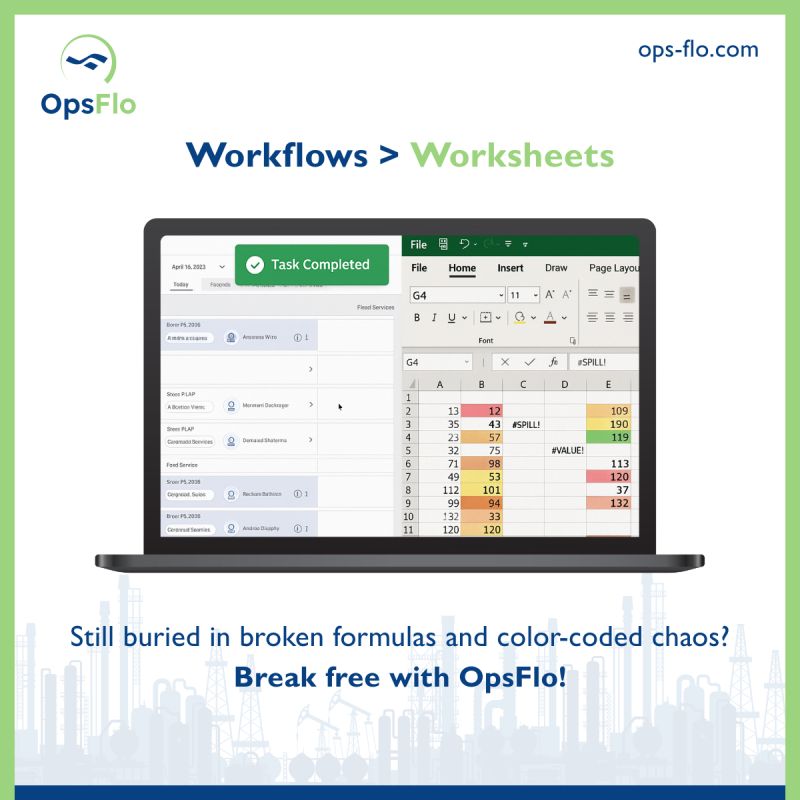
The spreadsheet is worse. The spreadsheet is a lie. It tells you that the data is organized. But the spreadsheet has no memory. It does not know that the ticket from last Tuesday was rejected because the pumper used the wrong unit number. It does not enforce rate cards. It does not flag that you billed 12 hours of standby on a job where the contract allows only 8. The spreadsheet is where billing goes to become a mystery.
You need software built for the oilfield. Software that understands the difference between a workover rig and a drilling rig. Software that knows the difference between a day rate and a footage rate. Software that can talk to the operator’s system without a human translating. That is the only way to bill oilfield jobs faster without creating a new mess in the back office.
Step-by-Step Operational Framework: From Field to Cash in 48 Hours
Here is the framework that works. It is not complicated. It is disciplined. It requires that you change the behavior of your field crews and your office staff. The software enforces the discipline. You provide the leadership.
Step 1: Capture the Ticket at the Source
The pumper, the wireline operator, or the toolpusher must enter the ticket data on a mobile device before they leave the location. No exceptions. No "I will do it when I get back to the shop." The data entry takes four minutes. The ticket is geotagged. The timestamp is automatic. The AFE number is pulled from the job schedule. The rate code is pre-populated based on the equipment type. If the pumper tries to enter 15 hours of standby, the system flags it because the contract allows only 8. The error is caught in the field, not in the accounting office 200 miles away.
Step 2: The Digital Signature Is the Contract
The company man signs the tablet. He does not like it at first. He will complain. He will say he prefers paper. You will tell him that a digital signature means he never has to track down a lost ticket again. He will sign. The signature is encrypted. The timestamp is irrefutable. The ticket is now a legal record. There is no dispute about whether he approved the standby time. It is in the system.
Step 3: The Back Office Reviews in Real Time
Your billing clerk does not re-type the ticket. She reviews it. She checks the math. She verifies that the pricing matches the contract. She looks at the exceptions. She flags the one ticket where the crew was on location for 14 hours but the job was scheduled for 10. She sends a note to the field supervisor for clarification. The ticket is not rejected. It is resolved in hours, not weeks.
Step 4: The Invoice Is Generated Automatically
The system aggregates the approved tickets into an invoice. The invoice is formatted to the operator’s specifications. It is sent electronically. It is posted to OpenInvoice or Cortex if the operator uses those platforms. Your clerk does not print, stuff, and mail. She clicks submit. The invoice is in the operator’s hands the same day the job is completed.
Step 5: The Cash Hits Your Account
Because the ticket is accurate and the invoice is compliant, the operator’s accounts payable does not kick it back. The payment cycle runs its course. You have cut 15 days off the cycle. You have eliminated the 8 percent dispute rate. You have turned your billing department from a cost center into a cash machine.
Permian Field Case Study: The Exact Metrics
Let me give you a real example. A pressure pumping company in the Permian Midland basin was running 12 frac spreads. They were billing $18 million per month. Their average invoice cycle was 52 days from job completion to payment. Their dispute rate was 9 percent. They had six billing clerks working overtime every month-end.
They implemented digital field ticketing with automated invoice generation. The change was not subtle.
- Cycle time: The average invoice cycle dropped from 52 days to 31 days. That is a 21-day improvement. They released $12.6 million in working capital.
- Dispute rate: The dispute rate fell from 9 percent to 1.5 percent. The remaining disputes were about pricing terms, not data entry errors.
- Billing staff: They reduced their billing clerk headcount from six to three through attrition. They did not fire anyone. They simply did not backfill the positions.
- Revenue leakage: They recovered $1.35 million per year in revenue that previously disappeared to discounts and write-offs.
- Field time: The average pumper spent 6 minutes per day on ticketing instead of 25 minutes. That is 19 minutes per day returned to supervising the job.
The company did not buy a new fleet. They did not hire a new salesperson. They did not cut their price. They simply got paid faster and kept more of what they earned. That is the entire game.
Implementation Checklist for Supervisors and Office Dispatch
You cannot buy this software and expect it to work by Friday. You must implement it with the same discipline you use to rig up a frac spread. Here is your checklist.
- Map your rate codes. Sit down with your pricing manager. Document every rate code you use. The day rate for the swab rig. The hourly rate for the vacuum truck. The standby rate. The travel rate. The mobilization fee. If you cannot define it, you cannot automate it.
- Clean your customer master data. The operator’s legal entity name must match their remit-to address. The AFE numbers must be in the system before the job starts. You cannot bill a job faster if you do not know who to bill.
- Train the field crews in person. Do not send a link to a training video. Send a supervisor to the yard. Show the pumpers how to enter a ticket on the tablet. Let them practice on a mock job. Answer their questions. They will resist change. Your presence tells them this is serious.
- Set a hard cutover date. On the first of the month, paper tickets are no longer accepted. If a crew comes back without a digital ticket, they do not get paid for that job until the ticket is resolved. That is harsh. It works.
- Run a parallel test for two weeks. Enter tickets in the new system while still doing the paper process. Compare the results. Find the gaps. Fix them before you flip the switch.
- Measure the cycle time weekly. Track the average days from job completion to invoice submission. Track the dispute rate. Track the days sales outstanding. Put the numbers on a whiteboard in the dispatch office. Make it a competition between crews.
Frequently Asked Questions
Will the company man actually sign a tablet?
Yes, but you must make it easy for him. The tablet must be rugged. The screen must be readable in direct sunlight. The signature field must be large. The process must take less than 30 seconds. If the software is clunky, he will refuse. If it is fast and reliable, he will prefer it because he will stop getting phone calls asking him to verify a paper ticket from three weeks ago.
What happens when the operator uses OpenInvoice or Cortex?
Your software must integrate with those platforms. You do not want to generate a PDF and then manually upload it to the operator’s portal. That is just a new form of the old problem. The right software will post the invoice directly to the operator’s system with the correct PIDX mapping. This is non-negotiable for the large operators in the Permian and the Haynesville.
How long does implementation actually take?
A focused company can go live in 30 to 45 days. The first week is data cleanup. The second week is configuration. The third week is training. The fourth week is the parallel test. The fifth week is the hard cutover. If your organization is scattered across multiple basins, add two weeks for travel and scheduling.
What if my crews are not tech-savvy?
The average pumper is smarter than you think. He can diagnose a triplex pump problem by sound. He can calculate mud weight in his head. He can learn a mobile app. The issue is not capability. The issue is motivation. If the crew knows that a complete digital ticket means they get paid on time, they will adopt it. If the office still accepts paper tickets as a fallback, they will ignore the app. Remove the fallback.
Clear Executive Takeaway
You have two choices. You can continue the current cycle. You can keep chasing paper tickets. You can keep arguing with accounts payable clerks. You can keep waiting 52 days for money you earned last month. You can keep borrowing at 15 percent to cover the gap.
Or you can change the system. Software to bill oilfield jobs faster is not about typing faster. It is about capturing the truth at the wellsite and moving that truth through your billing system without human interference. It is about turning your field data into cash in days, not months.
The companies that survive the next downturn will not be the ones with the most horsepower. They will be the ones with the most cash. They will be the ones who can bid aggressively because they know their cost of capital is lower. They will be the ones who do not carry $12 million in unbilled work on their books.
I have seen the difference this makes. I have seen a family-owned wireline company in the Eagle Ford go from borrowing against receivables to holding a cash reserve. I have seen a vacuum truck operator in the Bakken cut his back-office staff in half while growing revenue. The tool is the same. The discipline is the same. The only variable is whether you are willing to make the change.
Start with a ROI calculator to see the hard numbers for your operation. Then look at how digital field ticketing works in practice. When you are ready to stop leaving money in the field, request a request a revenue diagnostic. The diagnostic will show you exactly where your billing cycle is leaking cash. It will take one hour. It will be the most profitable hour you spend this quarter.
Your crews are doing the hard work. They are running the iron. They are pumping the sand. They are pulling the pipe. The least you can do is make sure their work turns into your cash. Accelerated oilfield billing is the answer. The question is whether you will act on it today or wait until the next slow month forces your hand.
No comments yet
Be the first to share your thoughts.
Leave a Reply
Comments are disabled on the shared-hosting build. If you want to respond to this article, email info@ops-flo.com and mention "Software To Bill Oilfield Jobs Faster Than Your Current Billing Cycle".
Contact OpsFlo